I'm concluding these days that I'm just a slow learner.
We moved from the densely populated flatland of Chicago Illinois to the sparsely populated mountains of Prescott Arizona six years ago.
My Illinois training was very inconsistent, resulting in middling to poor performance on occasional organized rides and events (Tour of the Mississippi River Valley [TOMRV], Balltown Classic, a few club century rides, and more distant events like the Ride Across Indiana [RAIN], the Assault on Mt. Mitchell, etc).
Putting in long hours and miles of training in Chicago meant driving for sixty miles to get out of the city. And one can do only so much useful training in the basement. Even after I made the switch from upright bikes to recumbent bikes I limited my rides to less than 200 miles.
When we moved to Arizona the terrain was `exciting' and more challenging. And, because I reduced my working days from 5 or 6 days a week to 2 days a week I had more time to ride and train. I immediately became infected with the `how high can you climb' bug. My training goals changed from `miles' ridden to `feet' climbed.
My Arizona training consisted of `epic' rides. Thirty miles and 2,500 feet of climbing. One hundred miles and 8,800 feet of climbing. While it is important to gain skill and capacity for climbing on the bike there is a potential down side (pun!).
Climbing big hills and mountains restricts your riding to `grind up' the hills and `coast down' the hills. Neither of these episodes in your training does much for building stamina. `Grinding' requires a steady, sub-threshold pacing. And `coasting' is nothing more than ... nothing. Too inconsistent for balanced training. One does not develop overall cycling capacity with `epic' training rides.
The RACE AROUND IRELAND piqued my interest when I investigated the course route, i.e., terrain, weather, distance, etc. A cycling acquaintance (Valerio Zamboni), with significant ultracycling credentials, entered the RAI six times and finished five times. Corresponding with Valerio he encouraged me to consider RAI.
Mounting the challenge of entering and finishing RAI involves significant investment of time and money. Completing 1,336 miles of cycling with 66,000 feet climbing within a five and a half day time limit is daunting. I traveled to Ireland to drive the RAI course recently and was pleased to find that it didn't include the bruising long or steep climbing of Arizona. The roads are good. The weather is wet and windy but doesn't involve dangerous 120F desert heat.
In other words, a balanced training regimen would go a long way toward successful accomplishment of this challenging athletic event.
Mindful that I had come up short on several past cycling challenges, and with the helpful advice of several cycling friends (Allan Duhm, Dennis Johnson, Paul Carpenter, Keith Kohan, and more) I am training like never before.
First, no `epic' climbing regimen. It is unbalanced and does little in the way of building stamina. Second, I have developed a three-part `formula' for my RAI training: consistency, volume and intensity. Third, the training course is weighted toward `miles' rather than `feet climbed.' The hours I put into any one training session include continuous pedaling effort, instead of the `grind' and `coast' circuit.
Consistency requires me to train 4 and 5 days each week. Volume comes next, i.e., carefully introducing the amount of time and number of miles I train during each training session. Finally, carefully introducing very measured intensity to my training. Too much volume and/or too much intensity can result in `overtraining,' that is, tearing down instead of building up fitness, stamina and capacity.
Friday, April 28, 2017


Saturday, April 22, 2017
RAI - Mizen Head Videos
Ten short videos of the entry to and exit from Mizen Head.
Not a travelogue. For those interested in the terrain and road quality.
With narration (of sorts).
Mizen Head
Not a travelogue. For those interested in the terrain and road quality.
With narration (of sorts).
Mizen Head
RAI - Videos of the Gap of Dunloe
Seven short videos of the entry to and exit from the Gap of Dunloe.
Not a travelogue. For those interested in the terrain and road quality.
The Gap of Dunloe
Not a travelogue. For those interested in the terrain and road quality.
The Gap of Dunloe
Tuesday, April 18, 2017
Driving the Race Around Ireland Course - V.1
I just returned from an eight day trip to and from Ireland. The purpose was to get a sense of the roads, drivers, terrain and anything else I could observe.
Driving the Race Around Ireland course was draining. In fact I didn't drive every road, turn and twist of the course. For that I would have needed another passenger, a navigator. Speaking with Alan Heary, the RAI owner, he noted that he drove it with race director, Emmett Roche, a few years ago and it took 12 hours a day for four or five days.
Rather, I drove several well known challenging sections of the course. This was done to assess the road surface quality and other aspects of the environs and terrain. I've concluded that the course is eminently doable. And, of course, I am referring to the recumbent.
Roads, Traffic and drivers. Most of the course is good quality chip seal. The route roads are typically narrow, sometimes allowing only the width of one vehicle. And on the other roads barely big enough for two vehicles. (I damaged the passenger side 'wing' mirror when driving through a short section of road repairs, hitting a 'men working' sign).
Safety. I saw many, many bicyclists on these roads - even the most narrow roads. In every case the drivers slowed down and (apparently) patiently waited for a safe way to pass them. I didn't see any drivers texting!
Weather. Though many Irish say that late August and September are the "best" months for this event they also warn of rain, wind and the tail end of hurricanes. Still ... doable.
Hills and Climbing. The course is 1,336 miles long. With the exception of a few very short `novelty' climbs (where the rider might be better off just walking - they are that short) the 60,000 feet of climbing is `cumulative.' That is, there is nothing like my local climbing in the mountains of Arizona. RAI has several sections of 2% - 4% grades. Many of these occur toward the end of the course, making them that much more unpleasant - but doable.
This trip confirms my training regimen and training goals: consistency, volume and careful but necessary intensity. Endurance cycling and sleep management. Hydration, nutrition.
Having a follow vehicle behind me will be very reassuring. Many times during this trip I said to myself: I'd rather ride this course than drive it.
I took a generous amount of video of the more challenging (and beautiful) sections and will post it all later.
`Later.' This is a short 4.5 minute video clip (Garmin VIRB-XE) I took while driving a section of the Gap of Dunloe.
Gap of Dunloe - April 2017
Driving the Race Around Ireland course was draining. In fact I didn't drive every road, turn and twist of the course. For that I would have needed another passenger, a navigator. Speaking with Alan Heary, the RAI owner, he noted that he drove it with race director, Emmett Roche, a few years ago and it took 12 hours a day for four or five days.
Rather, I drove several well known challenging sections of the course. This was done to assess the road surface quality and other aspects of the environs and terrain. I've concluded that the course is eminently doable. And, of course, I am referring to the recumbent.
Roads, Traffic and drivers. Most of the course is good quality chip seal. The route roads are typically narrow, sometimes allowing only the width of one vehicle. And on the other roads barely big enough for two vehicles. (I damaged the passenger side 'wing' mirror when driving through a short section of road repairs, hitting a 'men working' sign).
Safety. I saw many, many bicyclists on these roads - even the most narrow roads. In every case the drivers slowed down and (apparently) patiently waited for a safe way to pass them. I didn't see any drivers texting!
Weather. Though many Irish say that late August and September are the "best" months for this event they also warn of rain, wind and the tail end of hurricanes. Still ... doable.
Hills and Climbing. The course is 1,336 miles long. With the exception of a few very short `novelty' climbs (where the rider might be better off just walking - they are that short) the 60,000 feet of climbing is `cumulative.' That is, there is nothing like my local climbing in the mountains of Arizona. RAI has several sections of 2% - 4% grades. Many of these occur toward the end of the course, making them that much more unpleasant - but doable.
This trip confirms my training regimen and training goals: consistency, volume and careful but necessary intensity. Endurance cycling and sleep management. Hydration, nutrition.
Having a follow vehicle behind me will be very reassuring. Many times during this trip I said to myself: I'd rather ride this course than drive it.
I took a generous amount of video of the more challenging (and beautiful) sections and will post it all later.
`Later.' This is a short 4.5 minute video clip (Garmin VIRB-XE) I took while driving a section of the Gap of Dunloe.
Gap of Dunloe - April 2017
Saturday, April 8, 2017
Status - Training for Race Around Ireland
Three and a half months in and four and a half months to go before RAI (late August).
In a few days I'll travel to Dublin, Ireland, to `drive the course.' A little more than 1,300 miles and 60,000 feet of climbing. Because of the magnitude and cost of this cycling event I want no surprises - or, as few surprises as possible.
There are 23 time stations to the course, roughly 70 mile apart. Solo racers have 130 hours to complete the course and be considered `finishers.' This is a race, not a `ride.' To `finish' the racer must average just under 11 mph (17 kph) over the 130 hours. That may not sound difficult to do but this factors in the several hours off the bike, sleeping, as well.
I plan to use two Bacchetta short wheel base high racer recumbent bikes for the race. The first is the Titanium Aero. I've modified the bike, with a Kent Polk Railgun carbon fiber hardshell seat, a tiller and narrow (cut and welded) bullhorn bars. The second bike is the new Carbon Aero 3 bike.
Both bikes will have 650b wheels (smaller than standard 700 wheels). The Ti bike (medium frame) will be geared for rougher and hilly terrain with a compact crank (50/34) up front and a ten speed 11/36 cassette in back.
The CA3 will be about one and a half inches longer (large frame) than the Ti bike and will be geared for smoother and less hilly terrain (55/39 up front and 11/36 in back). I prefer the 650b wheels so I'll be modifying the CA3 to include a disc brake in back. That, as well as the Railgun seat, tiller and bullhorn bars.
Training. A major reason for my `drive the course' trip to Ireland is to get a first-hand appreciation for the terrain. Just as in my psychological practice where diagnosis drives treatment, in cycling the terrain drives the training. Living and cycling in the Arizona mountains is an up and down affair: sweat and grind to the top and then just hang on and steer on the way down. Not the kind of `balanced' endurance training a cyclist requires for varied terrain (like Ireland),
Finding a training course near my home that is not an extreme up and down slog has been difficult, but possible. (Skull Valley to Wilhoit and Back) Good, long flats, reasonable but demanding long climbs and descents. Almost `normal.'
I'm less worried about handling the terrain in Ireland (frankly). It is the twin factors of `endurance' and `sleep deprivation' that has my focus.
Consistency. Volume. Intensity. These are the three components of effective training. And, as a good friend has mentioned "That is a recipe for burnout!" Unless, of course, you slowly work your way through them.
Consistency and volume are most important in an ultrarace like RAI. Intensity (fast, hard, high heart rate, etc) is a dangerous entity, like an acid that wears through the other two.
In the past three and a half months I'm pleased (and somewhat surprised) that I've been able to train four out of every seven days of the week. Often I don't want to train but I keep the goal of finishing RAI in my sights. And that gets me out the door.
In the past two weeks I've carefully introduced `volume' to my training. Increasing the time (and miles) I spend on daily training sessions. Three to four and a half hours per training session. Four and five days each week.
At this point I'm doing o.k.. I feel the `stress,' take my naps during the day (when I'm not at the office). And am becoming more `efficient' with the use of my time.
Next week will be somewhat of an interruption of the schedule, given that I'll be in the air and on the road for nine days. On my return I'll carefully return to my current schedule of consistency and volume.
When I feel I'm ready (probably early May) to increase the `volume' I'll do it in a measured manner. Two and a half hours on the bike, rest for half an hour, another two and a half hours on the bike. Somewhere in this `ramp up' of volume I'll put in some long (seven to nine hour) training sessions. By July and August I'll be spending four to five days per week training with a few twelve hour training sessions every month. With fewer and shorter `rests' each training session.
(I reserve the right to modify everything - :)
In a few days I'll travel to Dublin, Ireland, to `drive the course.' A little more than 1,300 miles and 60,000 feet of climbing. Because of the magnitude and cost of this cycling event I want no surprises - or, as few surprises as possible.
There are 23 time stations to the course, roughly 70 mile apart. Solo racers have 130 hours to complete the course and be considered `finishers.' This is a race, not a `ride.' To `finish' the racer must average just under 11 mph (17 kph) over the 130 hours. That may not sound difficult to do but this factors in the several hours off the bike, sleeping, as well.
I plan to use two Bacchetta short wheel base high racer recumbent bikes for the race. The first is the Titanium Aero. I've modified the bike, with a Kent Polk Railgun carbon fiber hardshell seat, a tiller and narrow (cut and welded) bullhorn bars. The second bike is the new Carbon Aero 3 bike.
Both bikes will have 650b wheels (smaller than standard 700 wheels). The Ti bike (medium frame) will be geared for rougher and hilly terrain with a compact crank (50/34) up front and a ten speed 11/36 cassette in back.
The CA3 will be about one and a half inches longer (large frame) than the Ti bike and will be geared for smoother and less hilly terrain (55/39 up front and 11/36 in back). I prefer the 650b wheels so I'll be modifying the CA3 to include a disc brake in back. That, as well as the Railgun seat, tiller and bullhorn bars.
Training. A major reason for my `drive the course' trip to Ireland is to get a first-hand appreciation for the terrain. Just as in my psychological practice where diagnosis drives treatment, in cycling the terrain drives the training. Living and cycling in the Arizona mountains is an up and down affair: sweat and grind to the top and then just hang on and steer on the way down. Not the kind of `balanced' endurance training a cyclist requires for varied terrain (like Ireland),
Finding a training course near my home that is not an extreme up and down slog has been difficult, but possible. (Skull Valley to Wilhoit and Back) Good, long flats, reasonable but demanding long climbs and descents. Almost `normal.'
I'm less worried about handling the terrain in Ireland (frankly). It is the twin factors of `endurance' and `sleep deprivation' that has my focus.
Consistency. Volume. Intensity. These are the three components of effective training. And, as a good friend has mentioned "That is a recipe for burnout!" Unless, of course, you slowly work your way through them.
Consistency and volume are most important in an ultrarace like RAI. Intensity (fast, hard, high heart rate, etc) is a dangerous entity, like an acid that wears through the other two.
In the past three and a half months I'm pleased (and somewhat surprised) that I've been able to train four out of every seven days of the week. Often I don't want to train but I keep the goal of finishing RAI in my sights. And that gets me out the door.
In the past two weeks I've carefully introduced `volume' to my training. Increasing the time (and miles) I spend on daily training sessions. Three to four and a half hours per training session. Four and five days each week.
At this point I'm doing o.k.. I feel the `stress,' take my naps during the day (when I'm not at the office). And am becoming more `efficient' with the use of my time.
Next week will be somewhat of an interruption of the schedule, given that I'll be in the air and on the road for nine days. On my return I'll carefully return to my current schedule of consistency and volume.
When I feel I'm ready (probably early May) to increase the `volume' I'll do it in a measured manner. Two and a half hours on the bike, rest for half an hour, another two and a half hours on the bike. Somewhere in this `ramp up' of volume I'll put in some long (seven to nine hour) training sessions. By July and August I'll be spending four to five days per week training with a few twelve hour training sessions every month. With fewer and shorter `rests' each training session.
(I reserve the right to modify everything - :)
Tuesday, March 14, 2017
VIDEO - White Spar on the CA2
This is a rather lengthy video of a rather short ride.
I'm including about 2.5 minutes (beginning) of climbing up the White Spars because folks have asked "what is it like when you're climbing?" Answer? Slow and not really interesting except for the hordes of motorcyclists.
This is a useful training route to the extent that a) there is some climbing, b) the descents require some technical skill.
Note, during the last six minutes or so, that I employ a descending position that I call `the luge.' It simply allows me to become more aerodynamic. I usually `luge' when I'm on extended descents and exceeding 34 mph.
The Garmin Virb G-Metrix data flashes in and out of the video. Not sure why.
https://www.youtube.com/watch?v=V1MJ_eSArgI&feature=youtu.be
I'm including about 2.5 minutes (beginning) of climbing up the White Spars because folks have asked "what is it like when you're climbing?" Answer? Slow and not really interesting except for the hordes of motorcyclists.
This is a useful training route to the extent that a) there is some climbing, b) the descents require some technical skill.
Note, during the last six minutes or so, that I employ a descending position that I call `the luge.' It simply allows me to become more aerodynamic. I usually `luge' when I'm on extended descents and exceeding 34 mph.
The Garmin Virb G-Metrix data flashes in and out of the video. Not sure why.
https://www.youtube.com/watch?v=V1MJ_eSArgI&feature=youtu.be
Thursday, March 2, 2017
A Few Vids of Bike and Training Route / Course
The first video is of the Bacchetta Ti Aero recumbent rear wheel drive high racer. Only the first 9.5 minutes is relevant. I describe the bike and the many modifications that I've made to it.
Bacchetta Ti Aero
The second video is of the training route / course that I've been using lately. The location is an out and back from Skull Valley, AZ. I live `up the mountain' in Prescott, AZ, but it is literally 15F warmer just 13 miles away (and about 1,500 feet lower in elevation).
Skull Valley Training Route / Course
Here is the RWGPS data for this training session: https://ridewithgps.com/trips/13078739
Bacchetta Ti Aero
The second video is of the training route / course that I've been using lately. The location is an out and back from Skull Valley, AZ. I live `up the mountain' in Prescott, AZ, but it is literally 15F warmer just 13 miles away (and about 1,500 feet lower in elevation).
Skull Valley Training Route / Course
Here is the RWGPS data for this training session: https://ridewithgps.com/trips/13078739
Thursday, February 23, 2017
Race Around Ireland - Considerations and Planning
The RACE AROUND IRELAND is regarded as one of the toughest cycling challenges in the world and will take the racers on a 2,150 km /1,350 mile journey past some of the most stunning scenery in Ireland. The route will take you past Newgrange, The Causeway Coast, Malin Head, The Cliffs of Moher, The Ring of Kerry, Mizen Head, the Garden County (Wicklow) and back to Moynalty in County Meath and ALL within a week.
I pre-registered for RAI in January of 2017 and the `Go - No Go' decision is on April 1, 2017. RAI is a `race.' It is not a `ride.' As a solo racer I will have 132 hours (5.5 days) to complete it. If I finish in 132 hours and 1 minute ... it will be recorded as a `Did Not Finish / DNF.'
A challenge as formidable, complex and financially costly as RAI requires hard-headed thinking, planning and analysis. In my mind DNF'ing is not an option. Too many sacrifices to not be a proud finisher.
Below I am listing many of the factors that currently occupy my (remaining) mind as I approach the `Go - No Go' date. (At any one time each of these factors is a `priority.')
Age: I'm 71. As much as I have a hard time recognizing (admitting?) that fact there are certain physical imperatives. I'm in great shape but I know that, with age, my fitness and health are more brittle than when younger. At the moment I am in almost complete denial of these so I won't blather on about this. (I'm a psychologist so I know what I'm talking about 😔
Financial Cost: For me this is equally a moral issue and a practical matter.
If I allow my conscience to dictate my decision I devote these dollars to those whose needs are desperate. It is self-indulgent to do RAI when so many people experience poverty, illness and ignorance. I consider it my weakness - it is immoral - to spend so much money on RAI.
As I dial in the expenses I will absorb with RAI ... my `cheap Scot' muscle is getting overused. I swallow hard and rationalize it by saying "who wants to live forever?!"
RAI is not RAAM: Some may be aware of my concern that the RAAM course is more dangerous than it is worth. As a previous RAW participant, RAAM Official and RAAM Crew Chief my opinions are not `armchair.' In the US west the roads are narrow, vehicles include trucks, massive hay and livestock wagons, texting drivers and RVs (the worst). In the US midwest the roads are often straight for tens and tens of miles, dulling drivers minds and senses, with drivers (and cyclists) wandering into opposite lanes. In the US east the density of traffic increases all of these factors.
RAI has different problems but, as far as I can gather, the life-and-limb dangers are mitigated. Instead there are many country roads with poor quality pavement, narrow country roads, free range livestock, hundreds of hard to track and navigate turns.
Navigation: Past RAI crew and officials have informed me that the many turns, roads and road signs almost guarantee getting lost (junk miles). American crew/drivers are simply not used to driving on the `wrong' side of the road and get quickly lost in roundabouts. Irish or experienced RAI crew doing the navigation and driving seems to be a `must.'
Another navigation issue has to do with `reading' a cue sheet but not really getting a feel for distances. GPS guidance and detailed off-line (RWGPS) maps may allow the navigator to better assess distances, turns, etc.
Racer Communication: A helmet-mounted communication system, in my opinion, is a necessity for crewed ultra races. The Terrano System will allow firm and clear communication between racer and crew. Navigation. Nutrition. Clothing. Encouragement and problems.
Standard v. Recumbent Bike: I'm confident about my climbing ability, but that doesn't mean I won't walk up hills that are too steep to ride. By `too steep' to ride I'm referring to long 14%+ grades. Can I pedal up these hills? Yes. Is it efficient and wise (energy expenditure, potential for injury? No. I have nothing to prove regarding my climbing prowess.
Recumbent racing bicycles do have an aerodynamic advantage on flats and descents. When the terrain and road quality safely allow me to access that advantage I will. But many of the Irish roads are not suitable for fast descents. Perhaps even less so on a recumbent.
So racing on country roads will require acknowledgment that the recumbent advantage will be mitigated. Plan for it. Train for it.
Nutrition and Hydration: This is always challenging. I and my crew will have to set clear schedules and practices.
Sleep Deprivation: This applies to both the racer and the crew. All the research supports the conclusion that one cannot `train' for sleep deprivation. It must be acknowledged, planned for and managed.
Mechanical Issues: Two bikes. Three sets of wheels for each bike. Different gearing for each bike. Ridiculous redundancy for spare parts and supplies.
Weather and Clothing: Rain, cold, wind. Be prepared to be creative. Expecting to ride wet. Dry clothes ... I don't know how that will happen -- yet.
THE DEFINITION OF A FANATIC: A person who, when he loses sight of the objective, redoubles his effort. (Stupid)
Finally, I am not of the mind that sheer willpower and emotional and physical prowess result in successful ultra accomplishments. Sometimes we see the victor characterizing him or herself as being `unstoppable,' `a fighter,' etc. This is probably done to deal with the anxiety of fear and trepidation.
Yes, it requires determination. But it also requires rational calculation, sensitivity to recognize when the racer's cognitive processes are compromised, psychological calculations as to the racer and crew's processes, the crew's fatigue, and `fit' among members of the crew. Emotional awareness and capacity to restrain one self. To `respond' rather than to `react.'
After a relatively short time `in the saddle' most of what happens is from the neck up, not the neck down.
If the racer and crew do not admit that they are terrified I will give them three no cost therapy sessions.
I pre-registered for RAI in January of 2017 and the `Go - No Go' decision is on April 1, 2017. RAI is a `race.' It is not a `ride.' As a solo racer I will have 132 hours (5.5 days) to complete it. If I finish in 132 hours and 1 minute ... it will be recorded as a `Did Not Finish / DNF.'
A challenge as formidable, complex and financially costly as RAI requires hard-headed thinking, planning and analysis. In my mind DNF'ing is not an option. Too many sacrifices to not be a proud finisher.
Below I am listing many of the factors that currently occupy my (remaining) mind as I approach the `Go - No Go' date. (At any one time each of these factors is a `priority.')
Age: I'm 71. As much as I have a hard time recognizing (admitting?) that fact there are certain physical imperatives. I'm in great shape but I know that, with age, my fitness and health are more brittle than when younger. At the moment I am in almost complete denial of these so I won't blather on about this. (I'm a psychologist so I know what I'm talking about 😔
Financial Cost: For me this is equally a moral issue and a practical matter.
If I allow my conscience to dictate my decision I devote these dollars to those whose needs are desperate. It is self-indulgent to do RAI when so many people experience poverty, illness and ignorance. I consider it my weakness - it is immoral - to spend so much money on RAI.
As I dial in the expenses I will absorb with RAI ... my `cheap Scot' muscle is getting overused. I swallow hard and rationalize it by saying "who wants to live forever?!"
RAI is not RAAM: Some may be aware of my concern that the RAAM course is more dangerous than it is worth. As a previous RAW participant, RAAM Official and RAAM Crew Chief my opinions are not `armchair.' In the US west the roads are narrow, vehicles include trucks, massive hay and livestock wagons, texting drivers and RVs (the worst). In the US midwest the roads are often straight for tens and tens of miles, dulling drivers minds and senses, with drivers (and cyclists) wandering into opposite lanes. In the US east the density of traffic increases all of these factors.
RAI has different problems but, as far as I can gather, the life-and-limb dangers are mitigated. Instead there are many country roads with poor quality pavement, narrow country roads, free range livestock, hundreds of hard to track and navigate turns.
Navigation: Past RAI crew and officials have informed me that the many turns, roads and road signs almost guarantee getting lost (junk miles). American crew/drivers are simply not used to driving on the `wrong' side of the road and get quickly lost in roundabouts. Irish or experienced RAI crew doing the navigation and driving seems to be a `must.'
Another navigation issue has to do with `reading' a cue sheet but not really getting a feel for distances. GPS guidance and detailed off-line (RWGPS) maps may allow the navigator to better assess distances, turns, etc.
Racer Communication: A helmet-mounted communication system, in my opinion, is a necessity for crewed ultra races. The Terrano System will allow firm and clear communication between racer and crew. Navigation. Nutrition. Clothing. Encouragement and problems.
Standard v. Recumbent Bike: I'm confident about my climbing ability, but that doesn't mean I won't walk up hills that are too steep to ride. By `too steep' to ride I'm referring to long 14%+ grades. Can I pedal up these hills? Yes. Is it efficient and wise (energy expenditure, potential for injury? No. I have nothing to prove regarding my climbing prowess.
Recumbent racing bicycles do have an aerodynamic advantage on flats and descents. When the terrain and road quality safely allow me to access that advantage I will. But many of the Irish roads are not suitable for fast descents. Perhaps even less so on a recumbent.
So racing on country roads will require acknowledgment that the recumbent advantage will be mitigated. Plan for it. Train for it.
Nutrition and Hydration: This is always challenging. I and my crew will have to set clear schedules and practices.
Sleep Deprivation: This applies to both the racer and the crew. All the research supports the conclusion that one cannot `train' for sleep deprivation. It must be acknowledged, planned for and managed.
Mechanical Issues: Two bikes. Three sets of wheels for each bike. Different gearing for each bike. Ridiculous redundancy for spare parts and supplies.
Weather and Clothing: Rain, cold, wind. Be prepared to be creative. Expecting to ride wet. Dry clothes ... I don't know how that will happen -- yet.
THE DEFINITION OF A FANATIC: A person who, when he loses sight of the objective, redoubles his effort. (Stupid)
Finally, I am not of the mind that sheer willpower and emotional and physical prowess result in successful ultra accomplishments. Sometimes we see the victor characterizing him or herself as being `unstoppable,' `a fighter,' etc. This is probably done to deal with the anxiety of fear and trepidation.
Yes, it requires determination. But it also requires rational calculation, sensitivity to recognize when the racer's cognitive processes are compromised, psychological calculations as to the racer and crew's processes, the crew's fatigue, and `fit' among members of the crew. Emotional awareness and capacity to restrain one self. To `respond' rather than to `react.'
After a relatively short time `in the saddle' most of what happens is from the neck up, not the neck down.
If the racer and crew do not admit that they are terrified I will give them three no cost therapy sessions.
Monday, February 20, 2017
Weather Conditions - Clothing and Safety
Ugly
weather, clouds, rain, fog and cold in the mountains down to about 3,000 feet
elevation. Ambient temp was 39F / 7C. I decided to restrict
training yesterday to roads with wide shoulder. In such foggy and
cloud-encased weather cars, trucks, RVs and other vehicles may not see me until
it is too late -- even though I have eye-popping strobe lights both fore and
aft.
Clothing
was dialed in well. Protected me against wind chill (15F / -17C) on
descent. Able to shed some layers on return climb to keep from
overheating.
The
helmet visor became hard to see through because of the heavy rain. At
high speed descents I cannot afford visual distortion by rain drops. Same
with my glasses. So I took them both off. I had a bill cap that I
used at speed to minimize pelting rain. It worked really well. (You
have to make do and invent solutions).
I mounted my
Garmin VIRB camera on my helmet to record the conditions but too late realized
that ... the battery was dead. Still, it was interesting to have that `duck' on
my helmet on the screaming descent.
A major effort
over the past six months has gone into designing and building a head rest that
is comfortable, allows for steep recline in the seat and can be adjusted if I
need to sit up, i.e., less recline. I think I'm close to being on target
at this point. Soft enough to allow for no brain rattling when on rough
road, firm enough to allow stability, low enough so that the helmet doesn't
interfere, and at the right angle (90 degrees) allowing me good vision and
least vestibular complexity. Very lightweight, too. I'm pretty pleased
with this and will post a few pics soon.
https://ridewithgps.com/trips/13040403
Saturday, February 18, 2017
Friday, February 17, 2017
Race Around Ireland - 2017
Dan Fallon will become the first recumbent rider to attempt Race Around Ireland in August 2017. The Chicago native has had a fascinating journey to his first RAI. His inspiring and pioneering spirit will be a welcome addition to this year’s event. Dan will be raising funds for research on brain cancer through a charitable organisation, 3000 Miles to a Cure.
Don’t let his self-deprecating replies fool you. Anyone who goes looking for hills on a recumbent is one of cycling’s ‘hard men’.
Tell us a little bit about your cycling and racing history to date. Significant events/results etc.
I have no significant upright bike experiences except week-long tours, etc. On the recumbent I hold a UMCA record for fastest recumbent transit of Illinois and Indiana. I’ve entered several other events/races on the recumbent but I don’t consider my performances to be record setting.
Can we get some biographical information: Age, home town, currently residing, day job etc.
I’m 71. I live in the mountains of Arizona, Prescott. Along the RAAM route. I’m a doctoral level private practice clinical psychologist – 2 full days per week.
My wife and I moved to Prescott in 2011 (from Chicago). I prefer cycling in the mountains and the desert. The hot Arizona desert, at 2,000ft above sea level is 40 miles away. Our Prescott home is in the Arizona mountains at 6,000ft above sea level. I have the perfect training terrain.
THIS is a typical flattish training route a short distance from my home.
THIS is a typical flattish training route 60 miles south of my home, in the AZ desert.
And THIS is a typical hilly, switchback-laden, mountain training route literally at my front door. I’ll be doing this later today, when the black ice melts off the mountain roads.
You’ve said you have an Irish/Scottish connection, can you give us some details? Is this your first visit to Ireland? (If so, welcome!)
We understand the Fallons emigrated from Ireland to Scotland during the famine. My father was one of 17 brothers and sisters. They lived and worked in the coalmines near Edinburgh.
My mother’s side of the family (Dolan) came over from Ireland around the same time, during the famine. One of my grandfathers enlisted twice in the U.S. Army during the U.S. Civil War. The Dolan side of the family is distinguished for being career firemen, police officers, priests, nuns, lawyers.
I’ve never been to Ireland. Once to Scotland.
What brings you to Race Around Ireland? What have you heard about the event? What are your expectations in terms of how you will perform and what you will experience?
I’m not much of a spectator or tourist. It bores me to `look at’ stuff. If I’m travelling I need to be `doing’ something. I can’t think of a better way to visit Ireland than to do it in a race on a bike.
Valerio Zamboni is an ultra-cycling acquaintance. I’ve followed his exploits with envy. When I learned that he had done RAI six times I found that the idea was intriguing. Consulting with Valerio I decided to enter RAI.
I’m frankly surprised that no recumbent cyclist has entered RAI. Then again, I’m not surprised. There is a myth that recumbent cyclists don’t ‘like’ hills. The fact is that if a cyclist trains for the hills they will perform well in the hills.
I moved to Prescott largely because of the challenging mountain terrain. I have no physical limitations or problems that cause me to ride a recumbent (e.g., back problem, etc). I just like ‘bents. And I like to race other upright cyclists in the mountains and the hills.
In fact, I have never even MET a recumbent cyclist in my area. I train completely alone. Fast on the descent and typically faster than upright bikes on the climbing, depending on the course and/or event.
Tell us a little bit about riding a recumbent. The difficulties, the advantages and the joy that it brings. What are the specific technical and physical challenges involved and can you detail the specifics of the machine for equipment geeks: weight, height, length, tubing, componentry and, of course, the manufacturer.
I started riding the recumbent in 2008. After a week long training experience on my upright bike in Indiana I found that it was getting boring. A friend suggested recumbents but I thought they were for old men with fat bellies and white beards. Nevertheless, I bought a recumbent and less than a month later completed a 160 mile race with almost no sensation of fatigue … and at a very good speed.
The next year I took the UMCA recumbent records for fastest transit across Illinois and Indiana. The year after that I entered the Race Across the West and DNF’d in Congress, AZ, after 400 miles in 24 hours. I didn’t train enough.
Since RAW I’ve done all kinds of events with the goal of enjoying myself and learning my limits.
Riding in the mountains results in performance capabilities that don’t easily translate to riding in the flats. In the flats the cyclist has to maintain a steady pace without let up. In the mountains the cyclist learns power and pacing on the climbs and is then rewarded with (often) screaming technical descents.
The upside of riding a racing recumbent is that the racer doesn’t experience sore shoulders, neck fatigue, wrist and hand numbness. The downside of riding a racing recumbent is that the racer doesn’t get to throw the bike around, is pretty much locked into a stationary position on the bike.
An upright acquaintance asked me how long it would take for him to get his ‘climbing legs’ on a first-time recumbent vacation in the Italian Dolomites. I told him: “Six months.” He didn’t believe me. He returned from Italy humbled.
Climbing on a recumbent requires patience, discipline and a willingness to experience ridicule from many upright cyclists. Descending on a recumbent requires humility and grace when I scream past upright cyclists who are spinning out at 50 mph.
With time, training and experience a recumbent bike … is just a bike. It is the cyclist that makes the difference.
I ride rear-wheel drive recumbents. Bacchetta CA2 and Bacchetta Ti Aero. I’ve modified these bikes to be more aerodynamic and to enable delivery of power to the legs.
Tell us a bit about your crew. Who’s supporting you? Are they a regular Fallon team?
I will be bringing my crew chief to RAI: Billy Broadfoot. He is a master bike mechanic and has decades of cycling racing experience. I hope to hire three more crew in Ireland.
I’ve had various people crew for me on events, from family and friends to almost complete strangers. It is not an exaggeration to state that building the right crew is critical to a good race.
Finally, how’s the training going this year? How are you preparing for RAI? Are you riding other events?
It is 20-30 degrees colder in the mountains than 40 miles south in the desert. So most of my training in December and January has been ‘south.’ Still, in January I managed to squeak out 650 miles and 25,000 feet of climbing.
Training in the mountains doesn’t equate to ‘miles ridden.’ A 32-mile course with 3,000ft of climbing is entirely different than on the flats. Last February I did a race in Florida (Sebring): 185 miles with less than 1,800ft of climbing. I get 1,800 feet of climbing on 20 miles `up here.’
My plan is to build endurance on rolling and hilly terrain. Although there are some leg-breakers on RAI they do not demand the cyclist to train on leg-breaking mountains to do well. So, rolling and hill training. Probably 1,200 – 1,800 miles per month with less than 50,000 feet of climbing.
Next week I’ll put in an 8 hour event at a local training course.
Time on the bike will be the purpose.
In March I have a 200-mile event (Joshua Tree Double Century) planned.
In April I will be doing a 24-hour event in Houston, Texas (Bessie’s Creek).
May to August I’ll probably stay local to focus on rolling and hilly terrain, with several 24-hour solo events.
Friday, December 30, 2016
Cycling as a Priority
While training today I found myself tired, sore, cold and wet. Asking myself the important question: worth it or not worth it? And the essential corollary: is cycling a priority?
Ranked in priority:
Living up here in the Arizona mountains and having nothing remotely resembling level ground makes training ... complicated. I don't like even the `idea' of driving tens of miles to find terrain that is warmer, flatter and drier.
An hour and a half away (and 4,000 feet lower, and 20F degrees warmer) means I have a 3 hour commute. Vulture Mine Road Vulture Mine Road is an excellent training course for several reasons: good road, almost no traffic, a mix of level and hills, no ice or snow. But it ... is 3 hours away.
Nearby (literally right outside my door) is some of the most challenging terrain I know of. Prescott High Country Again, the roads are smooth, traffic is minimal, most drivers are regulars (I often get a `wave' as they go by). But the altitude makes for ice and snow. And a climbing experience requiring preparation and serious consideration.
Over the past few weeks I've focused on a `high country' course with good road, wide shoulders and minimal traffic. But it is a `killer': Prescott - Kirkland Junction - Out and Back The return leg is 25 miles and 3,400 feet of climbing, getting steeper (7 - 11% grades) as you reach the top end of the course. I have to dress for freezing wind chill (descending into 35F at up to 50 mph for 13 miles), `warmer' low country, and sweaty climbs back up.
But it is GREAT training.
Ranked in priority:
- Wife
- Family
- Work
- Political Activity (Trump is a threat to all that the U.S. Constitution stands for)
- Cycling
Living up here in the Arizona mountains and having nothing remotely resembling level ground makes training ... complicated. I don't like even the `idea' of driving tens of miles to find terrain that is warmer, flatter and drier.
An hour and a half away (and 4,000 feet lower, and 20F degrees warmer) means I have a 3 hour commute. Vulture Mine Road Vulture Mine Road is an excellent training course for several reasons: good road, almost no traffic, a mix of level and hills, no ice or snow. But it ... is 3 hours away.
Nearby (literally right outside my door) is some of the most challenging terrain I know of. Prescott High Country Again, the roads are smooth, traffic is minimal, most drivers are regulars (I often get a `wave' as they go by). But the altitude makes for ice and snow. And a climbing experience requiring preparation and serious consideration.
Over the past few weeks I've focused on a `high country' course with good road, wide shoulders and minimal traffic. But it is a `killer': Prescott - Kirkland Junction - Out and Back The return leg is 25 miles and 3,400 feet of climbing, getting steeper (7 - 11% grades) as you reach the top end of the course. I have to dress for freezing wind chill (descending into 35F at up to 50 mph for 13 miles), `warmer' low country, and sweaty climbs back up.
But it is GREAT training.
Friday, December 23, 2016
Cold Weather Clothing
We're supposed to get 8 inches of snow tomorrow so more `clothing' testing will be delayed for a few days.
Where I live one is either climbing or descending. Nothing is remotely flat, or even `flattish.' Today's training session is the classic example.
https://ridewithgps.com/trips/12333556
A 12.2 mile descent with 2,000 feet elevation loss. At 6014 ft elevation I started out in a grey cloud fog, making any eye glasses or eye gear useless (lenses fogged up on inside and had obscuring rain drops on outside).
Descending at 42 mph into a 12 mph headwind at 43F on wet (though excellent) road made for careful going. The National Weather Service [url="https://www.weather.gov/epz/wxcalc_windchill[/URL] windchill calculator puts the windchill figure at below 30F. Which I don't accept. Perhaps the rain and fog, being wet, made it feel more like in the mid-teens.
I wore
All tight and tucked for the extended descent (37 minutes).
On the climb back up the balaclava, second pair of gloves came off. And I unzipped the jerseys. Still no glasses.
As I got above 5,200 feet (and colder and foggier) the second pair gloves came back on and I zipped up.
It was quite a fashion show.
Where I live one is either climbing or descending. Nothing is remotely flat, or even `flattish.' Today's training session is the classic example.
https://ridewithgps.com/trips/12333556
A 12.2 mile descent with 2,000 feet elevation loss. At 6014 ft elevation I started out in a grey cloud fog, making any eye glasses or eye gear useless (lenses fogged up on inside and had obscuring rain drops on outside).
Descending at 42 mph into a 12 mph headwind at 43F on wet (though excellent) road made for careful going. The National Weather Service [url="https://www.weather.gov/epz/wxcalc_windchill[/URL] windchill calculator puts the windchill figure at below 30F. Which I don't accept. Perhaps the rain and fog, being wet, made it feel more like in the mid-teens.
I wore
- Armwarmers made from woolen tube sox ($6 compared to $35 brand armwarmers).
- A merino wool long sleeve jersey.
- Two merino wool short sleeve jerseys.
- My favorite low tech Giordana clear plastic rain jacket (and wind shell).
- Two pairs of gloves (Coolibar fingerless and a no-name full fingered wool set).
- A balaclava with a thin cotton skull cap.
- Polypropylene leggings.
- And a simple pair of Aerotech Design shorts.
All tight and tucked for the extended descent (37 minutes).
On the climb back up the balaclava, second pair of gloves came off. And I unzipped the jerseys. Still no glasses.
As I got above 5,200 feet (and colder and foggier) the second pair gloves came back on and I zipped up.
It was quite a fashion show.
Thursday, December 22, 2016
Wet, Windy, Wild Way to Climb My Way into Winter.
A fitting way to start the winter.
3,488 feet of climbing on the 25 mile return leg of a 50 mile out and back. Most of the climbing done in the last 13 miles of the route.
Temp dropped 20F, a driving rain, cold SE crosswind the last 15 miles of climbing. Lots of 8+% grades. Road excellent. I felt like I had been in a fight - and won - by the time I finished.
The descent wasn't as boring as it usually is because of the challenge of the driving wind and rain. Still, managed to push 48+ mph for a good bit. The steeply reclined (4 degrees) position, use of the ``Luge / Bobsled' ' position , the Railgun seat, tiller and `handlebar on my chest' technique delivered the results I want.

3,488 feet of climbing on the 25 mile return leg of a 50 mile out and back. Most of the climbing done in the last 13 miles of the route.
Temp dropped 20F, a driving rain, cold SE crosswind the last 15 miles of climbing. Lots of 8+% grades. Road excellent. I felt like I had been in a fight - and won - by the time I finished.
The descent wasn't as boring as it usually is because of the challenge of the driving wind and rain. Still, managed to push 48+ mph for a good bit. The steeply reclined (4 degrees) position, use of the ``Luge / Bobsled' ' position , the Railgun seat, tiller and `handlebar on my chest' technique delivered the results I want.

Friday, October 28, 2016
Modified Handlebar on Tiller


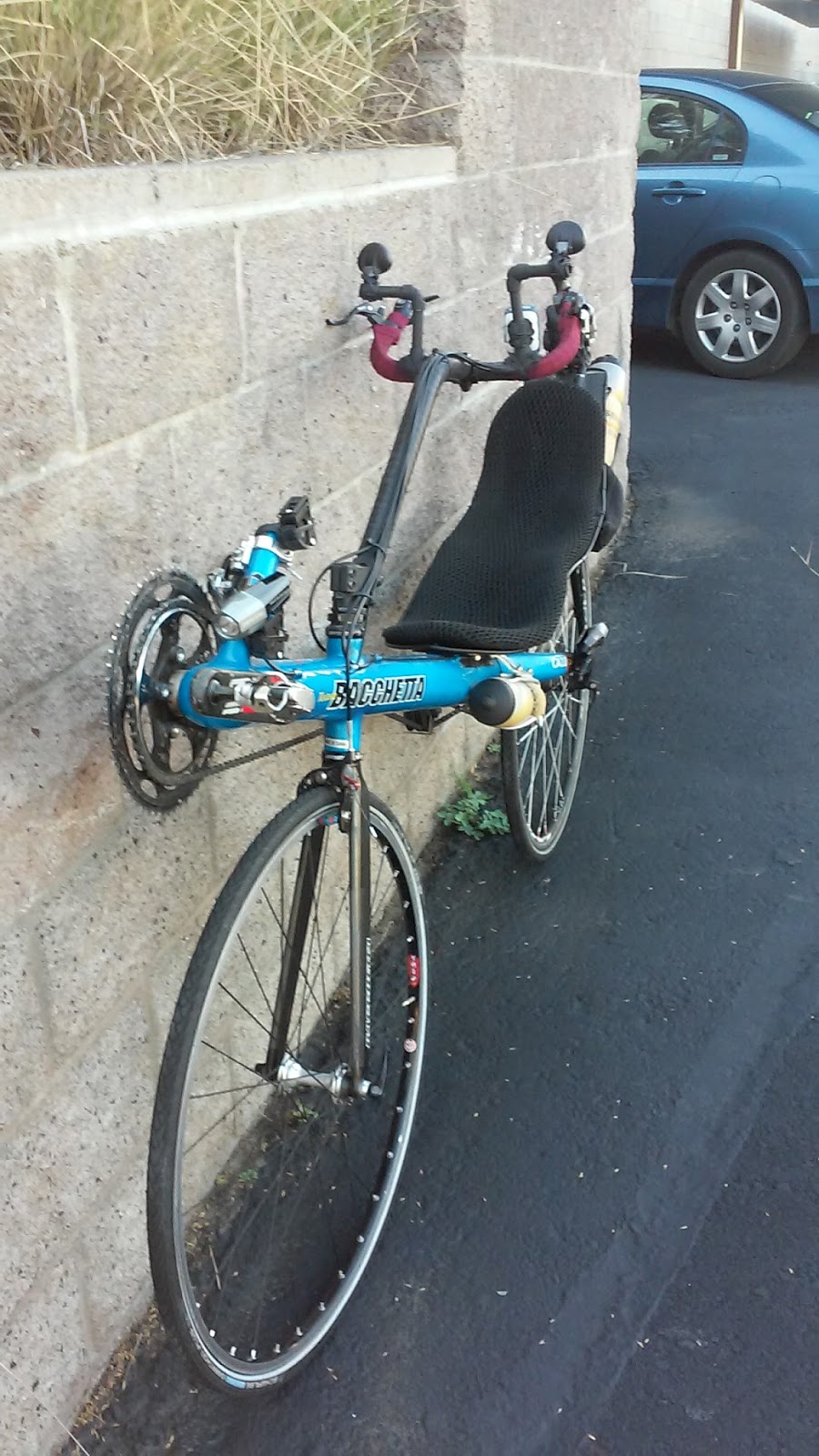


The mini bullhorn handlebar that I used on the tiller was not `mini' enough. The steering with the tiller and mini bullhorn was rock solid, nonetheless. Brakes, R2C levers ... excellent.
In order to reduce wind drag and to make it even more comfortable I reduced the width of the bullhorn handlebar by 60 mm, i.e., 30 mm from either side of the section onto which the tiller clamps. I then had it welded together again.
The pic above is the before and after.
Wednesday, October 26, 2016
Sliding Down the White Spar
I think I'm in the final stages of recovery from a three week bout of the most mysterious flu. Started out like most flu episodes (head filled with snot, coughing), then moved into laryngitis and finally persisted as two weeks of low energy and high need for sleep.
With ten days to a 12 hour time trial at Borrego Springs I finally got back on the bike for a quick up'n'over the Bradshaw mountain on the White Spar.
Kept it low and slow most of the way. The conditions were good for fast descents, though. On the last 2.5 miles of the ride it is all downhill and switchbacks. Glass smooth road. Posted speed limit ranges between 30 - 45 mph.
As I began the descent I noted a car about 30 yards behind me preparing to pass. Usually I just pull over and wave the vehicle past so that I don't have to deal with the hassle. This time, however, I was having just too much fun, and knowing I wasn't going to overtrain on the descent. So I pushed it.
Riding the Spars
For the first 100 yards I pedaled hard to get to `escape velocity.' Then I assumed the `luge' position and took advantage of the 4 - 6 degree angle of descent. With the combination of the luge and tucking tightly I was able to accelerate to 45 mph as I approached the first `gentle' curve. The car behind became distant as it complied with the 30 mph limit.
For the next mile I continued the luge and the tuck. When my speed reduced to 38 mph I engaged the pedals again and cranked hard and fast (115-120 rpm due to the fact that my big ring on the Ti Aero is only a 50t).
I expected the car behind to pass me but I think he was having a good time watching me have a good time. He stayed well behind me all the way to the end.
That was fun.
With ten days to a 12 hour time trial at Borrego Springs I finally got back on the bike for a quick up'n'over the Bradshaw mountain on the White Spar.
Kept it low and slow most of the way. The conditions were good for fast descents, though. On the last 2.5 miles of the ride it is all downhill and switchbacks. Glass smooth road. Posted speed limit ranges between 30 - 45 mph.
As I began the descent I noted a car about 30 yards behind me preparing to pass. Usually I just pull over and wave the vehicle past so that I don't have to deal with the hassle. This time, however, I was having just too much fun, and knowing I wasn't going to overtrain on the descent. So I pushed it.
Riding the Spars
For the first 100 yards I pedaled hard to get to `escape velocity.' Then I assumed the `luge' position and took advantage of the 4 - 6 degree angle of descent. With the combination of the luge and tucking tightly I was able to accelerate to 45 mph as I approached the first `gentle' curve. The car behind became distant as it complied with the 30 mph limit.
For the next mile I continued the luge and the tuck. When my speed reduced to 38 mph I engaged the pedals again and cranked hard and fast (115-120 rpm due to the fact that my big ring on the Ti Aero is only a 50t).
I expected the car behind to pass me but I think he was having a good time watching me have a good time. He stayed well behind me all the way to the end.
That was fun.
Friday, October 7, 2016
Tiller and Stem: Bacchetta Stick Bike
A year and a half ago I modified my Ti Aero and CA2 steering setup from a stock riser and handlebar to a tiller and stem.
This is a pic of the stock riser and handlebar setup:

I found that the riser impeded my ability to see ahead of me. That was the primary basis of my interest in the Cruzbikes. This is a pic of one of the three (Vendetta, Silvio and Sofrider) Cruzbikes I owned (Silvio):

The front wheel drive of the Cruzbike is problematic for me for several reasons I won't describe here. I returned to the Bacchetta stick bike frame and rear wheel drive.
I then became interested in a different bike that had both a tiller setup and rear wheel drive, the M5 Carbon High Racer (pic):

But I chose against this bike for two reasons: didn't want to spend the money and the chain interferes with right hand turning (wheel hits the chain). In my terrain the fast, descending switchbacks would pose a problem with the chain / wheel issue.
My compromise response was to modify the Bacchetta bikes I have to obtain a) the tiller and stem setup, b) a much more reclined seat, c) retain the rear wheel drive. This is a picture of Kent Polk's initial use of the tiller, stem and custom make reclined carbon fiber hard shell seat:

I ordered from Kent the Railgun seat for both my Bacchetta bikes. It makes a profound beneficial difference. I then ordered the tiller and stem setup from Performer Bikes in Taiwan.
Others using the Performer Bikes tiller and stem modified it so that it angled down to the level of recline the rider wants for the Railgun seat. So that the tiller stops, and doesn't land in your lap, others had drilled a hole in the stem and inserted a strong bolt. This is a pic:

Two things to note on the picture above. First, in order to get the angle at which the tiller `fits' the rider's preference I had to tap several holes, experimenting. Second, given that I didn't want the strong bolt hitting the stop point on the stem (metal on metal) I had to `cushion' the stop point with pieces of strong rubber, lashed to the stem with cable ties.
Quickly I concluded that the bolt, rubber and cable ties was not a long-term solution. In fact, after a long and dangerous cycling event (Hoodoo 300) the bolt simply fell out on a training ride.
To eliminate this problem I welded a piece of aluminum to the tiller and welded an aluminum channel into which I inserted a `soft' stop (again, strong rubber):


I am able to adjust the angle at which the tiller stops simply by adjusting the length of the rubber inserted into the stem channel. The rubber is firm and snug in the channel eliminating the possibility of falling out.
You will also note that I welded the tiller itself to the stem. Previously it had been attached to the stem with a simple seat clamp. That is problematic. The seat clamp can loosen and the tiller and handlebars can swivel, completely eliminating steering control.
This is a pic of the stock riser and handlebar setup:

I found that the riser impeded my ability to see ahead of me. That was the primary basis of my interest in the Cruzbikes. This is a pic of one of the three (Vendetta, Silvio and Sofrider) Cruzbikes I owned (Silvio):
The front wheel drive of the Cruzbike is problematic for me for several reasons I won't describe here. I returned to the Bacchetta stick bike frame and rear wheel drive.
I then became interested in a different bike that had both a tiller setup and rear wheel drive, the M5 Carbon High Racer (pic):

But I chose against this bike for two reasons: didn't want to spend the money and the chain interferes with right hand turning (wheel hits the chain). In my terrain the fast, descending switchbacks would pose a problem with the chain / wheel issue.
My compromise response was to modify the Bacchetta bikes I have to obtain a) the tiller and stem setup, b) a much more reclined seat, c) retain the rear wheel drive. This is a picture of Kent Polk's initial use of the tiller, stem and custom make reclined carbon fiber hard shell seat:

I ordered from Kent the Railgun seat for both my Bacchetta bikes. It makes a profound beneficial difference. I then ordered the tiller and stem setup from Performer Bikes in Taiwan.
Others using the Performer Bikes tiller and stem modified it so that it angled down to the level of recline the rider wants for the Railgun seat. So that the tiller stops, and doesn't land in your lap, others had drilled a hole in the stem and inserted a strong bolt. This is a pic:

Two things to note on the picture above. First, in order to get the angle at which the tiller `fits' the rider's preference I had to tap several holes, experimenting. Second, given that I didn't want the strong bolt hitting the stop point on the stem (metal on metal) I had to `cushion' the stop point with pieces of strong rubber, lashed to the stem with cable ties.
Quickly I concluded that the bolt, rubber and cable ties was not a long-term solution. In fact, after a long and dangerous cycling event (Hoodoo 300) the bolt simply fell out on a training ride.
To eliminate this problem I welded a piece of aluminum to the tiller and welded an aluminum channel into which I inserted a `soft' stop (again, strong rubber):


I am able to adjust the angle at which the tiller stops simply by adjusting the length of the rubber inserted into the stem channel. The rubber is firm and snug in the channel eliminating the possibility of falling out.
You will also note that I welded the tiller itself to the stem. Previously it had been attached to the stem with a simple seat clamp. That is problematic. The seat clamp can loosen and the tiller and handlebars can swivel, completely eliminating steering control.
Thursday, September 8, 2016
Hoodoo 300 - A Report
A week and a half ago I entered the Hoodoo 300 24 hour race in Utah. http://hoodoo500.com/300-2/
I completed 250 miles and 15,500 ft of climbing in 22 hours before I ended it. I knew I couldn't finish the last 50 miles before the time limit (24 hours) and there was no reason to put my excellent crew through the `drag' of me grinding away for another 4 hours just to do 300 miles.
I am really very pleased with my performance on the HD300. And I could not have had a better crew. I have to say that again:
Two vehicles. Crew 1 followed me, leapfrog, to the halfway point (155 miles, 9,000 ft of climbing, Panguitch, Utah). Crew 1 then `turned me over' to Crew 2 for the last half.
I arrived at the halfway point in 12 hours, 2.5 hours ahead of schedule (per my conservative plan). It rained literally the entire 150 miles. Heavy weekend RV traffic almost the entire way. My crew was amazing, providing me food and hydration, minor mechanical help and a heap of a lot of encouragement.
At Panguitch we attached night lights and headed off to the most difficult section of the course, 31.5 miles and 4,400 feet of climbing. I had scheduled to do this in 4 hours but it took me 6 hours. I fell off the bike 6 (maybe 7) times in the last 12 miles, as the grade increased to steady 6% - 8%+. I was going too slow, I wandered back and forth on the road, finally just tilting over.
By the time we got to the top of the climb (10,600 ft elevation) the temperature had dropped to 37F and I was soaking wet with perspiration.
The next section of the course was a 24.6 mile, 5,500 foot descent to Cedar City. At 2:00AM. My crew helped me change clothing to deal with the windchill (easily in the early 20Fs) on the descent.
About 10 miles into the descent, and at about 30 mph, I managed to thread the needle among the bloody remains (blood, bones, organs, front half carcass) of a huge deer that was killed by a truck less than an hour earlier.
Five miles after that, at about 35mph, I had an explosive front tire blowout. I managed to remain upright, putting my feet/cleats quickly to the road, creating a bright trail of sparks into the black of night.
Replacing the front wheel we continued on down to Cedar City where I changed bikes (from my `climbing' bike, the Bacchetta Ti Aero) to my `rolling terrain' bike (the Bacchetta CA2).
While we were doing this (3:30AM) another Hoodoo 300 racer without a crew asked if he could pile into the crew vehicle, as he was `toast' and couldn't ride another mile.
I continued on for another 40 miles, 30 miles of which was more climbing, but at a more manageable angle (2% - 4%). (I remember saying to Billy as he handed me a water bottle, "I could do without this damned climbing!!"). I asked him "What time is it?" and he gave me the bad news: I had just over 2 hours left before the race clock stopped, regardless of when I got to the official finish line in St. George, Utah. Realizing that I had no chance of doing the remaining 50 miles in the time limit I `called it.'
There we were. At the only gas station (closed, but it had bright overhead lights) for nearly 25 miles in all directions. Two recumbent bikes, one upright bike and four spare wheels wrangled to the top racks. Four tired guys, our gear, supplies, tools, etc, jammed tightly (but warmly!) into my Subaru Outback.
I routinely use a `bobsled / luge' (YouTube Video) method of descending on long descents. I developed this technique several years ago. (Today I rode a descent that usually sees me doing 41 mph in a `lazy' luge but came up with a solid 47 mph (really, really tucked).
On the HD300, descending down that killer hill I was in the luge the entire way. But not to `go fast.' I'm thinking that the `luge' position allowed me greater recovery and stability with that explosive blowout. Instead of having to unclip both feet I only had to unclip the left foot. The tiller position also helped me keep a low center of gravity. Not to mention that the Ti Aero is `shorter' than the CA2.
Looking at my Garmin 500 data on the descent from that mountain I kept it in the early 30's and late 20's all the way. I was feathering the brakes all the way because
I'm not really interested in exceeding 50 mph simply because of the safety angle. No point to it. Sure I can probably push close to 60+ but ... at what risk. And any time saved at such speed is immediately lost within a few miles of normal road. I'm just surprised at how safe and productive the luge position really is.
So, if all holds together and I try it again next year, my training has to include more extended climbing (https://ridewithgps.com/
I completed 250 miles and 15,500 ft of climbing in 22 hours before I ended it. I knew I couldn't finish the last 50 miles before the time limit (24 hours) and there was no reason to put my excellent crew through the `drag' of me grinding away for another 4 hours just to do 300 miles.
I am really very pleased with my performance on the HD300. And I could not have had a better crew. I have to say that again:
I COULD NOT HAVE HAD A BETTER CREW
- Allan Duhm, Crew Chief - Crew 2
- Billy Befoot, Mechanic - Crew 2
- Mike Cash, experienced RAAM Crew person and Mechanic - Crew 1
- Paul Gagnon, Crew person and Domestique par excellence - Crew 1
Two vehicles. Crew 1 followed me, leapfrog, to the halfway point (155 miles, 9,000 ft of climbing, Panguitch, Utah). Crew 1 then `turned me over' to Crew 2 for the last half.
I arrived at the halfway point in 12 hours, 2.5 hours ahead of schedule (per my conservative plan). It rained literally the entire 150 miles. Heavy weekend RV traffic almost the entire way. My crew was amazing, providing me food and hydration, minor mechanical help and a heap of a lot of encouragement.
At Panguitch we attached night lights and headed off to the most difficult section of the course, 31.5 miles and 4,400 feet of climbing. I had scheduled to do this in 4 hours but it took me 6 hours. I fell off the bike 6 (maybe 7) times in the last 12 miles, as the grade increased to steady 6% - 8%+. I was going too slow, I wandered back and forth on the road, finally just tilting over.
By the time we got to the top of the climb (10,600 ft elevation) the temperature had dropped to 37F and I was soaking wet with perspiration.
The next section of the course was a 24.6 mile, 5,500 foot descent to Cedar City. At 2:00AM. My crew helped me change clothing to deal with the windchill (easily in the early 20Fs) on the descent.
About 10 miles into the descent, and at about 30 mph, I managed to thread the needle among the bloody remains (blood, bones, organs, front half carcass) of a huge deer that was killed by a truck less than an hour earlier.
Five miles after that, at about 35mph, I had an explosive front tire blowout. I managed to remain upright, putting my feet/cleats quickly to the road, creating a bright trail of sparks into the black of night.
Replacing the front wheel we continued on down to Cedar City where I changed bikes (from my `climbing' bike, the Bacchetta Ti Aero) to my `rolling terrain' bike (the Bacchetta CA2).
While we were doing this (3:30AM) another Hoodoo 300 racer without a crew asked if he could pile into the crew vehicle, as he was `toast' and couldn't ride another mile.
I continued on for another 40 miles, 30 miles of which was more climbing, but at a more manageable angle (2% - 4%). (I remember saying to Billy as he handed me a water bottle, "I could do without this damned climbing!!"). I asked him "What time is it?" and he gave me the bad news: I had just over 2 hours left before the race clock stopped, regardless of when I got to the official finish line in St. George, Utah. Realizing that I had no chance of doing the remaining 50 miles in the time limit I `called it.'
There we were. At the only gas station (closed, but it had bright overhead lights) for nearly 25 miles in all directions. Two recumbent bikes, one upright bike and four spare wheels wrangled to the top racks. Four tired guys, our gear, supplies, tools, etc, jammed tightly (but warmly!) into my Subaru Outback.
I routinely use a `bobsled / luge' (YouTube Video) method of descending on long descents. I developed this technique several years ago. (Today I rode a descent that usually sees me doing 41 mph in a `lazy' luge but came up with a solid 47 mph (really, really tucked).
On the HD300, descending down that killer hill I was in the luge the entire way. But not to `go fast.' I'm thinking that the `luge' position allowed me greater recovery and stability with that explosive blowout. Instead of having to unclip both feet I only had to unclip the left foot. The tiller position also helped me keep a low center of gravity. Not to mention that the Ti Aero is `shorter' than the CA2.
Looking at my Garmin 500 data on the descent from that mountain I kept it in the early 30's and late 20's all the way. I was feathering the brakes all the way because
- I knew I was tired,
- the windchill was easily into the low 20's, maybe even teens,
- critters (as noted with that deer carcass). Most folks unfamiliar with such mountainous terrain at night will quickly nail a few deer or javelinas.
I'm not really interested in exceeding 50 mph simply because of the safety angle. No point to it. Sure I can probably push close to 60+ but ... at what risk. And any time saved at such speed is immediately lost within a few miles of normal road. I'm just surprised at how safe and productive the luge position really is.
So, if all holds together and I try it again next year, my training has to include more extended climbing (https://ridewithgps.com/
Subscribe to:
Posts (Atom)