Sunday, August 1, 2021

Bacchetta CA-2 - Standard Set Up

Three months ago I had rotator cuff surgery.  I'm cleared to do outdoor training at this point.  Most of my other bents have a tiller, mini bullhorn bars, levers and a Kent Polk Rail Gun seat.  The steeply reclined (4%) Rail Gun seat is ideal for most riding.  And I much prefer it over the Standard set up.  

In the meantime I am getting my bike handling skills back up to speed on mostly flat(ish) terrain with very minimal vehicular traffic.  The less steep recline (12-17%) adds stability at low speeds.  If I become unbalanced for some reason I can just throw a leg out to stay upright.  

I `re-converted' my CA-2 back to the standard set up, with a few minor bells and whistles for convenience.  Below find many pics.

---------------------------------------------------------------------

UPDATE: (Sep 12) I just swapped out the standard Bacchetta Carbon Fiber Hardshell Seat for the Kent Polk Rail Gun seat.  The Bacchetta CFHS seat has an upcurve at the bottom that a) irritates the gluteus maximus muscle, the iliotibial tract and the biceps femoris muscle, b) contributes to what I remember as `recumbutt'.  

With the Rail Gun seat I kept the angle of recline the same as with the Bacchetta CFHS seat, i.e., 18%. 

A much more comfortable ride.  And this continues to allow me the stability of `throwing a leg out' if there is some instability.


Sunday, July 4, 2021

Clipless Sandals

Just before I took off from Oceanside, CA, for the 2010 Race Across the West (RAW) I decided to switch from my Sidi clipless shoes to my Shimano clipless sandals. Making a last minute change in gear before a long race is very, very unwise. But I was worried that with the closed box Sidi's my feet would swell, be cramped and I'd suffer painful `hotfoot' after a few hours. 

My sandals were pretty typical, i.e., open toed with two velcro straps. It would allow for swollen feet and offer the chance to avoid `hotfoot.' 

I got lucky. It worked. 

Yet, after about 350 miles the nerves on the balls of my feet, pressed against the hard surface of even the open toed sandal, became irritated and I wound up `nursing' my feet after that. Painful. 

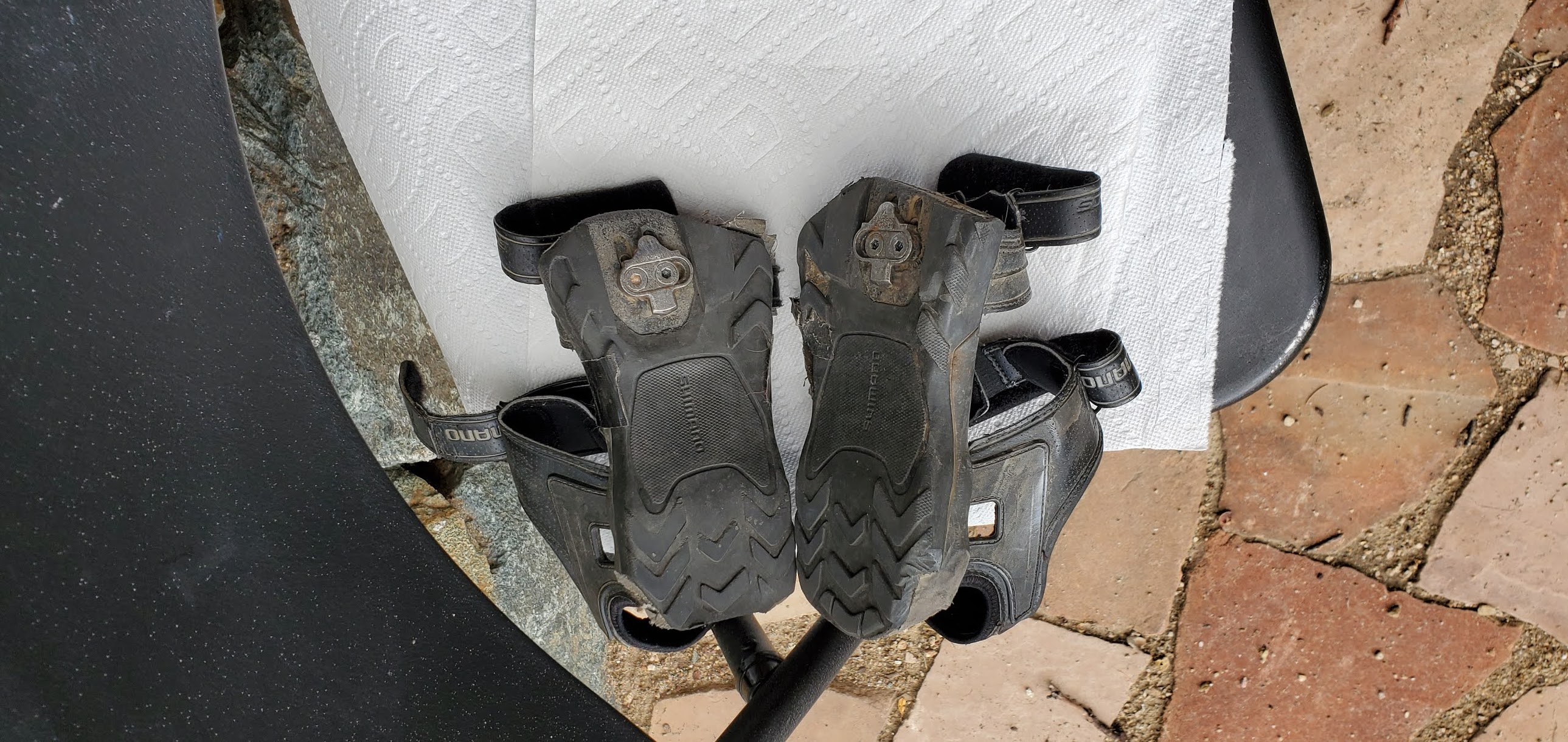
Over the years I've modified the sandals quite dramatically. In the winter I want to wear warmer socks and foot coverings so I took the sandals to a local shoe repair shop and had them extend the velcro straps. This allowed me to get more `foot' into the sandal and still strap them tight. 

But still, after hours of pressure on the balls of my feet (especially when climbing for 20 miles) it still resulted in painful nerve irritation. 

Then, about two years ago I decided to take a hacksaw to my shoes and cut off the part of the sandal on which the balls of my feet pressed against. What the heck! I used `Shoe Goo' to fill any gaps in the shoe last. 

The cleat is literally at the edge of the shoe. Yet it is still firm and connects firmly to the pedal. 

The sandals can be strapped (velcro) tight, which makes for a mid-sole cleat. Or the sandals can be slightly loose, allowing me to slide the foot back in the sandal to put the balls of my feet directly on the cleat and pedal. 

For me, this is the perfect setup for clipless pedals and long hours in the saddle. I've attached several pics for you to `see' what it looks like. 

Ugly. No bling. But I have the best of all worlds.

Saturday, May 22, 2021

Washington Post - LATE IN LIFE ATHLETES


They didn’t start running competitively until late in life. Why are they winning?

Nancy Simmons at the 2019 USA Track and Field Masters Mile Championships in Flint, Mich., where she set an age-group record.

The day after her last teenager was accepted into college, Ruby Ghadially, then 57, did something she views as a mark of regained independence: She went for a run. Though she had been active as an adult, she had primarily cycled, and it showed.

“It was a pitiful run,” recalled Ghadially, a dermatologist and researcher on aging at the University of California at San Francisco. “My run was exactly a half a mile from my house to the golf course in the Presidio.” She stopped to rest because she couldn’t breathe and came back. “I know I ran a 14- or 15-minute mile.”

Despite her late start as a runner, Ghadially, now 63 and a member of the San Francisco-based elite Impala Racing Team, will soon be back on the track trying to better her personal best, a 6:09-minute mile — which is only 29 seconds off the world record for her age group.

 At the same time many older people are giving up athletic activities, others are taking up running. And they’re not just plodding along in Turkey Trots or fundraising 5Ks — like Ghadially, they’re beating same-age peers who have trained for decades, winning national-level races and coming close to or setting age-group records.

Nancy Simmons, a 61-year-old teammate of Ghadially’s, took age-group firsts at New York’s 5th Avenue Mile and the USA Track and Field Cross Country Championships in 2020. Simmons also set an age-group record at the 2019 USA Track and Field Championships just 10 years after she began running competitively.

“I got divorced at 51 and had to do some personal reinventing, including finding new social groups,” Simmons said.

 Brian Pilcher gave up running at Dartmouth College after a sledding accident, he said, because he was more interested in partying and surfing. It wasn’t until his son started running cross-country in 2006 that Pilcher returned to the sport. Inspired by the sense that he could improve his speed, Pilcher started racing and quickly succeeded at a variety of distances. “They say you can’t PR [set a personal record] every time out, but I did,” said Pilcher. Despite the 30-year hiatus from running, during which he was a self-admitted couch potato, the 64-year-old Pilcher has set U.S. age-group records in the marathon, half-marathon and 5-km. He is also a four-time winner of the Dipsea Race, a legendary trail race in Northern California.

“It’s universally true that people like myself, and people much better than me, who were winning races 50 years ago are not the fastest in our age group now even though we are still running,” said Amby Burfoot, 74, winner of the 1968 Boston Marathon and a running and fitness writer for publications including The Washington Post. “The people that are beating us, I wouldn’t say they started yesterday, by any means, because it takes a number of years to get to your potential. But they are runners in many cases who were not stars — or even runners — when they were young.”

Most people assume that top masters athletes (in running, this class applies to competitors 40 and above) are lifelong exercises, said Hirofumi Tanaka, a professor of exercise science at the University of Texas at Austin who researches aging. “If you look around among all the masters athletes, there are not many who were elite athletes when they were young,” he said. “Most of the athletes are pretty new, and they are able to improve.”

The people who successfully start a late-in-life running career generally fall into three categories, said Michael Joyner, a physician and human performance researcher at the Mayo Clinic.

“There are the people that are good athletes that got brought into running, that have been physically active,” Joyner said. “The other group are those that had a ‘Come to Jesus’ moment, in some cases leading an unhealthy lifestyle before they got into running. The last is someone who was a good runner young but took time off and got good late.”

Burfoot said he can’t really answer why he isn’t winning races anymore. “I pound my head against the wall every day asking that question. Because the truth is, given the choice, I would be perfectly happy winning races. Yet that it is not the case.”

 While it’s true that he and other lifelong runners might have “tired legs” from running tens of thousands of miles, he said, “I can turn that around and say, ‘Wait a minute, I thought that training is what builds up all your systems, cardiovascular and structural.’ So why shouldn’t my 100,000 miles make me better than the guy that has only run 20,000 in the last 10 years?”

 Tanaka has been thinking about this, too. “I think the purpose of exercising actually changes,” he said. Elite athletes, he added, have always competed for medals. It’s different for people who start running in middle age or later. “In terms of recognitions on the podium, you really don’t experience that when you get older.”

The reasons to run cited by Ghadially and Pilcher indeed seemed to be more internal.

People “ask me, ‘Why are you running so much?,’ and I say, ‘I’m running away from old age,’ ” said Ghadially. 

Pilcher says runners who have been training and racing for decades may not have the same motivation. “They don’t have something to prove,” he said. “I always knew I could run fast, but I wanted to prove it.”

 Pete Magill, an author and successful masters runner, isn’t surprised that the casual exercisers of yesteryear have become the masters speedsters of today. His reasoning is that two important factors — innate running ability and longevity — don’t share the same timeline. “It would be very odd indeed if the runners blessed with the top ability when younger also possessed the greatest longevity,” Magill said via email. “In fact, I suspect that only the very best runners are able to successfully compete as masters runners.” That would require a scenario, he said, in which “their lack of world-class longevity is offset by the remains of world-class physical ability.”

 Magill says the pool of top older runners is most likely drawn from the subset of those who are lucky enough to rank high both in physical ability and in longevity, and who have good coaches, healthy lifestyles and the drive to compete long after their physical peaks.

 It would make sense that, if we accept that there is variability in the physiological components of running, there would be variability in the rate of decline in those very elements. A closer look at work by Romuald Lepers, a researcher at the University of Bourgogne in France, indicates the rate of decline might vary anywhere from 4 to 10 percent per decade. That would mean that even if two runners of equal fitness finish a race together at 30 years old, they might finish in significantly different times at 50.

For some lifelong athletes, the decline in running performance is due to an accumulation of injuries, even the small ones that many runners pick up after a lifetime of pounding the pavement. The frayed tendons and thinning cartilage, and the time and energy it takes to rehab them, can limit training, ultimately hurting performance. 

 “In that sense,” said Tanaka, “people that have never exercised in the past have an orthopedic reserve, if you will. That you have an intact orthopedic system that you can actually engage even at older age.”

 And though masters-age runners have seen their performance peak come and go — in the case of endurance athletes it’s around the mid-30s — it’s still possible for them to make large improvements, especially in aerobic capacity. 

Aerobic capacity, or VO2 max, which is the highest amount of oxygen consumed in exercise that combines all large muscle groups, is one of three determinants of running performance; the other two are lactate threshold, the highest level of aerobic capacity that can be sustained, and running economy, a measure of efficiency of motion. Of the three, researchers note the largest age-related decline in aerobic capacity, which begins to fall at about 40 years old.

“When you put the three determinants into an aging scheme, the running economy doesn’t seem to change, the lactate threshold doesn’t really change either,” said Tanaka. “So, most of the decline in endurance performance is determined by your maximal aerobic capacity. That seems to be the primary determinant that predicts your endurance performance” and the key to improving it.

Perhaps no better example of the potential to improve late-age performance exists than Robert Marchand, a 109-year-old French cyclist who owns the cycling hour record (the distance a cyclist can ride in one hour) for the 100-plus age group. After setting the initial record at the age of 101, Marchand thought he had more in the tank and sought to better his own mark. Two years later, at 103, Marchand was able to set another hour record, after which scientists were able to document a 13 percent increase in his aerobic capacity.

Running, with its relative simplicity of technique, might especially lend itself to a late-career renaissance, according to Burfoot. While it may be true that you can’t teach an old dog new tricks, that doesn’t stand in the way of improving at distance running, “because there is no trick to learn.” Runners essentially have the skills they need, he said. Improving is just a matter of arriving at a time in their life when they decide to dedicate themselves to the process.

 Discovering an aptitude for competitive running entails dedication and consistency. If you learn that you have these qualities when you’re 50, said Burfoot, “you can be one of the top runners in the world five or seven years later, perhaps.”


Friday, April 23, 2021

MEDICAL MIRACLE MAKES FOR MORE MILES


  • Just met with the doc after 4 weeks of medical assessment and will be getting outpatient arthroscopic rotator cuff surgery in two weeks.  
  • While climbing Yarnell grade five weeks ago the rear wheel slipped on a clump of hay (from hay wagon), rear wheel slipped and right pedal torque made bike go down (left side ... no derailleur damage, thank god).  Took impact on left shoulder.  Tore supraspinatus tendon (rotator cuff).  In past 4 weeks tendon has retracted 4 cm already.  
  • Failure to get surgery will result in further retraction, development of arthritis and probable candidacy for reverse shoulder replacement.  
  • Six months no outdoor cycling while tendon reattaches to shoulder joint (ball at top of humerus).  Critical rest and PT to get tendon firmly attached.
  • Indoor training not a problem.  So ... no competition and awards this year.  Next year will be incredible!
  • Very aggressive plans for indoor training.  
  • Absolutely miraculous.  Two fake knees. And the miracle of surgery to get shoulder in top shape for crushing cycling competition in last half of my eighth decade.  
  • We live in amazing times.  

Friday, April 16, 2021

Another Police Report of Dangerous Driver - April 16, 2021


Yavapai County Sheriff's Office:

Over the past month I and other cyclists have been `buzzed' and harassed by a driver on Kirkland Road (between Hillside and Kirkland - both directions).  I've ignored this at least a dozen times but the driver persists in this dangerous driving.  

I'm linking you to two YouTube videos (very short) of the event that occurred today.  


Someday this fellow is going to miscalculate and kill someone.  Or there is going to be a sudden crosswind pushing the cyclist a few inches into the road surprising the driver and killing the cyclist.  

I and many others would appreciate even a telephone call to this fellow to let him know that he is being video'd and will be held accountable for dangerous harassment or worse.  

On the video (front view) I can barely make out the license plate to be: 
  • Arizona passenger vehicle --------.  
  • A green 4 door sedan.  
  • Probably ten or more years old.  
Two fellows with `cowboy' hats were sitting in the front.  

I make a very deliberate effort to not hassle you with whining and complaining.  However, when this fellow repeats and repeats this dangerous driving it is only a matter of time before somebody on a bike gets hurt.

Thank you again.

Sunday, April 4, 2021

Fake Knees, Fake Ears, Fake Teeth, Fake Eyes ... Providential

Really, this is getting to be both very, very strange and very, very funny. 

Mid-eighth decade.  And I continue to push hard in cycling.  Actually improving, in fact.

While climbing up Yarnell Grade, from Congress, Arizona, a few weeks ago I rolled over a clump of slippery hay that had fallen off a hay wagon.  As I put force to the pedal the rear tire slipped on the hay and I fell over (left side).  My first concern when something like that happens is the rear derailleur.  But since I fell on the left side ... no problem there.  

Remounting the bike (Bacchetta Pelso-Brevet) I noticed a sharp twinge in my left shoulder.  This wasn't a `new' thing.  Over the past several years I'd notice a little pain there at times, but it went away very quickly and didn't constitute an impediment.  But this time it persisted.  Now, two weeks and several nights of `iffy' sleep I know I'm on a familiar trajectory. 

A few months of cortisone shots to get me through the bicycling season and then in late November or December ... a `Fake Shoulder' surgery.  Some healing, therapy and ... back to normal. 

UPDATE: Xray and MRI show no bone damage or arthritis.  A small tear on rotator cuff.  No surgery.  Time, careful physical therapy and it should be fine.

Frankly, what we now consider `normal' is nothing less than miraculous.  

Fifty years ago my parents and others of their generation didn't have these miracles available.  My mother died of heart failure after years of painful arthritis and simple family vulnerability to blocked arteries.  I lived in an immigrant neighborhood where older Italian ladies would gather on their front stoops shelling lima beans ... while virtually blind with clouded over eyes - cataracts.  My grandfather just folded over one day at age 76 from blocked arteries.  Both my sisters would joke that when they had dental problems they'd just put their false teeth in a box and mail them off to the dentist to get fixed.  "WHAAAAAAT?!!!" was the common expression from folks in their middle age, suffering from hearing loss.  

Me?  Two total knee replacements.  Hearing aids.  Dental implants.  Cataract surgery.  Drugs to virtually eliminate a family history of blood pressure problems and atherosclerosis.  Resting heart rate in the 40's and perfect blood pressure.  

With a careful diet and exercise my only worry is that meteorite with my name on it.  

But I'm also aware of my good fortune.  Luck.  Accident of birth.  Elderly white guy in a developed nation (even with all the faults).  


Thursday, February 25, 2021

First Gravel Bike Ride

It has been close to 12 years since I did any riding on what would be considered a `standard' upright / diamond frame bike.  All the bicycling I've done since then has been on one form of recumbent bike or another.  

Rather than get a typical `road' bike with relatively narrow tires and is used for paved, open roads I got a `gravel' bike.  A gravel bike has `fat' tires with lots of knobby protrusions for better traction on dirt or gravelly roads.  

The primary reason I added a gravel bike has to do with a determination to not accumulate `limitations' as I age.  Another reason is that I want to become more physically capable.  The gravel bike will develop upper body strength and overall balance (vestibular system).  Finally, I want options for physical expression.  Living where I do there are enormous opportunities for bicycling in all types of terrain; mountains, paved roads, long stretches of lightly traveled dirt roads.  

Today I took the gravel bike out for the first time.  Here are my impressions.

Balance.  I was concerned that the upright posture would be difficult to adjust to.  It wasn't.  Although sitting on an elevated platform (bicycle seat) is like climbing to the top of a mast on sailboat (rocks more, a more twitchy balancing demand) I adjusted quickly; less than ten minutes.  Paradoxically, my recumbent bikes are more stable being lower to the ground.  

Knees.  I have two fake knees (2018 and 2019).  They're better than the gnashed up, arthritic knees they replaced.  Though recumbent cycling employs leg and hip muscles differently I found no problem.  Of course, I have developed good muscle, tendon and ligament function in the legs because of the stress I put on them in climbing long and steep hills on the recumbent.  

Butt. Sitting on a bicycle seat can hurt.  The longer you do it the more it may hurt.  Also, there is soft tissue chafing that can result in serious `saddle sores.'  Not so on a recumbent bike.  It's like sitting on a comfortable cushion, the weight is distributed on the seat.  

Bike shorts with and without padding.  In order to reduce upright bike saddle sores the bike shorts have a padding (chamois) cushioning the hard saddle-to-butt experience.  Recumbents don't require a chamois.  When I initially put the upright bike shorts on it felt like I was wearing a diaper.  But when I sat on the gravel bike seat that feeling went away as I rode.  The chamois did do the job.  But it is well understood that the longer you sit on an upright bike saddle the more the chafing and the greater the chance you will develop painful saddle sore issues.  

Shoulders, neck and hands.  Perhaps the most common complaint with upright bikes has to do with pain, soreness and even nerve damage to these parts of the body.  Leaning forward to hold the handlebars, shifters and brakes causes stress on the shoulders, neck and hands.  I did experience this while riding the gravel bike today.  And it brought back very unpleasant memories from when I rode upright bikes in the past.  

Rather than be dissuaded from riding the gravel bike due to this problem I will be doing shoulder and neck exercises to hopefully lessen this problem.  

Road surface.  Just because the tires are much wider on a gravel bike it doesn't mean I can safely steer and maintain balance.  The road I was on today had patches of loose sand and rocks.  Despite a big tire up front I still had to be careful.  

All in all I'm happy about the gravel bike.  It will take time to adjust to it but I can already see many hours and miles ahead on the gravel bike.  

Sunday, February 7, 2021

DANGEROUS TRUCK DRIVER

February 8, 2021

U.S. Department of Transportation
Director, Office of Enforcement and Compliance
Golden Hills Office Centre
12600 W. Colfax Ave. Suite B-300
Lakewood, CO 80215 

Sir/Madam:

The purpose of the correspondence is to file this formal complaint and report the dangerous and potentially fatal operation of a (---) Road Transport, Inc., eighteen wheel truck and flatbed trailer. I have uploaded videos of this event to a YouTube channel (below)as material evidence.   

I was almost killed by a (---) Road Transport, Inc., truckdriver yesterday while riding my bicycle on a remote Arizona road.

YOUTUBE VIDEO FROM BEHIND:

  Truck Coming From Behind

 - 0:03:12 on video

YOUTUBE VIDEO FROM THE FRONT:

Truck Cutting Me Off In Front

                     - 0:03:20 on video

It was a bright, sunny afternoon with no weather-related problems.  There was no observable traffic coming in the opposite lane.  The driver dangerously entered the opposite lane, crossing a double yellow line, on a blind uphill curve, restricting vision / observation as to whether there was an oncoming vehicle in the other lane.  

I was dressed in bright, hi viz, iridescent yellow cycling clothes. I wore bright white knee length socks as my legs went up and down on the pedals. 

The bike had three (3) bright, flashing white and red strobe lights rear-facing, and one (1) bright white front-facing strobe lights.  

I was traveling at 30 mph, having just descended a steep hill, as far to the right as possible without being forced off the road into guard rail and steep ditch. 

A (---) Road Transport, Inc., Cab # 2677 18 wheeled flatbed truck was hauling steel railroad rails to Kirkland, Arizona.  (At 0:03:26​ on video).  It was traveling eastbound on Yavapai County Road 15 (Bagdad Road) on Saturday, February 6, 2021, at 2:30 PM. 
 
The truckdriver, traveling in excess of the stated speed limit (50 mph), pulled within three (3) feet of me from behind on bicycle. He then abruptly crossed into the opposite lane on a blind uphill curve, and then sharply cut back into the eastbound lane with the truck trailer within one (1) foot of hitting me. 

No traffic was observable by me on the limited observable section of the blind uphill curve in opposite lane. No vehicles were behind the truck. No vehicles were in front of me.  The limited observable road appeared free of traffic or any obstructions or impediments.

I am requesting that you investigate this incident to determine if there were actions on the part of the driver that were not lawful and were dangerous.  I will fully comply with any requests you make of me in this investigation.
  • Truckdriver in CAB # 2677.
  • Cab License Plate: PA10743 (Issuing State not readable)
  • Trailer License Plates: 9194SU (Alaska?); TA09934 (Issuing State not readable)
  • USDOT No.: 30161
Attachment: USDOT Correspondence: Review No.: 837404/CR, November 12, 2010.
 
CC:   

U.S. Department of Transportation
Director, Office of Enforcement and Compliance
Federal Motor Carrier Safety Administration
1200 New Jersey Avenue SE
Washington, DC 20590


SUCCESSFUL OUTCOME:

This morning (less than 30 hours after I contacted the corporate headquarters of the (---) Road Transport, Inc. in Copenhagen, Denmark) I received this email:

Mr. Fallon

I received the email below from our corporate office. Please know that we have reviewed the video, we have identified the contractor/driver and we have issued cancellation of his lease agreement.


Please accept our apologies for his actions and know that we take safety very seriously.


I would like to request that you remove the Youtube video. One guy's action is not reflective of the entire fleet's behavior and it is a detrimental to the remainder of our contractors.


If you would like to discuss further, feel free to give me a call at your convenience. 


Best regards,


(Name)

Manager of Safety

---------------------------------------------------------------------------


I've removed the name of the truck company but these videos can be very useful in advocacy to make the roads safer.  Ideally, all roads should include a wide shoulder on both sides for non-motorized travel, including running, walking, cycling.   


Tuesday, January 26, 2021

HOW TO REPORT DANGEROUS DRIVERS USING A VIDEO CAMERA


January 16, 2021 

Yavapai County Sherriff’s Office

255 E. Gurley Street

Prescott, Arizona 86301

Sir / Madam: 

I had earlier (01-15-2021) sent you an email about a cycling incident that occurred on Friday, January 15, 11:40 AM on the road directly in front of (west) the Mormon Temple (7785 Iron Springs Rd) In Kirkland, Az. 

I have enclosed a USB / thumb drive with the following video files and picture: 

·        1-FALLON-011521-FRONT (MP4) – video

·        2-FALLON-011521-REAR (MP4) – video

·        3-FALLON-011521-FrontStrobeLight (MP4) – video

·        4-FALLON-011521-RearStrobeLight (MP4) – video

·        5-STROBE – (MP4) - video

·        6-REAR-3STROBES – (JPG) – pic 

DESCRIPTION OF EVENT: 

I was beginning a cycling training session heading south on Iron Springs Road immediately west of the Mormon Temple.  My bike was situated to the right (west) of the white fog line on the road.  I had not yet engaged the pedals (clipless) and the bike was not moving.  I was sitting on the `saddle’ / seat of the bike.  I was stationary. 

I noted a few vehicles on Iron Springs Road moving / heading north.  I looked up and saw a line of vehicles in the opposite lane approaching my position. They had not yet crossed the bridge.   I was waiting for the vehicles to pass me.  I never begin or stop a cycling training session when vehicles are approaching. 

I was looking at the front (big) ring on the bike and cycling computer to assure I was in the correct gear and that the computer was in the `ON’ status.    At that `instant’ I noted a white passenger vehicle that had moved out of the northbound lane and into `my’ southbound lane, accelerating to approximately 45 mph in an effort to pass the vehicle in front of it.  On review of the video (2-FALLON-011521-REAR (MP4)) this vehicle had an Arizona license plate # XXXXXXXXX (0:03:15).  The vehicle had already crossed the double solid yellow lines and was moving further west toward me, still to the right of the white fog line (1-FALLON-011521-FRONT (MP4)) – (0:02:48). 

I had no time to move the bike or `jump’ off the bike into the shoulder of the road.  As the video shows (0:02:48) the vehicle continued to approach me.  

At the time of this incident it appeared that the vehicle was veering further to the west and would likely collide with me.  At the last second (to my immediate left / east) the vehicle abruptly `jerked’ back toward the northbound lane.  

  1. This vehicle initiated passing the vehicle ahead of it while crossing the double yellow line;
  2. This vehicle was, in my estimate, traveling far in excess of the 25 – 35 mph speed limit;
  3. The driver of this vehicle failed to respond to the very, very bright forward facing flashing strobe light affixed to the front of my bike;
  4. The driver of this vehicle failed to respond to the fact that I was wearing a high viz iridescent yellow jacket, long bright white stockings and shorts that were emblazoned with equally high viz iridescent yellow stripes;
  5. I estimate that the vehicle passed me with less than twelve (12) inches between us.
  6. The vehicle did not have the front headlights on. 

The videos and picture I have provided in the USB / thumb drive show the bright, flashing white and red strobe lights (1 strobe light in front, 3 strobe lights in back, 2 of which are in red) affixed to my bike.  

I am requesting that you investigate this incident to determine if there were actions on the part of the driver that were not lawful and were dangerous.  I will fully comply with any requests you make of me in this investigation. 

Again, thank you.  You can be certain that I will not abuse your time and energy with less grave incidents.