Sunday, June 7, 2015

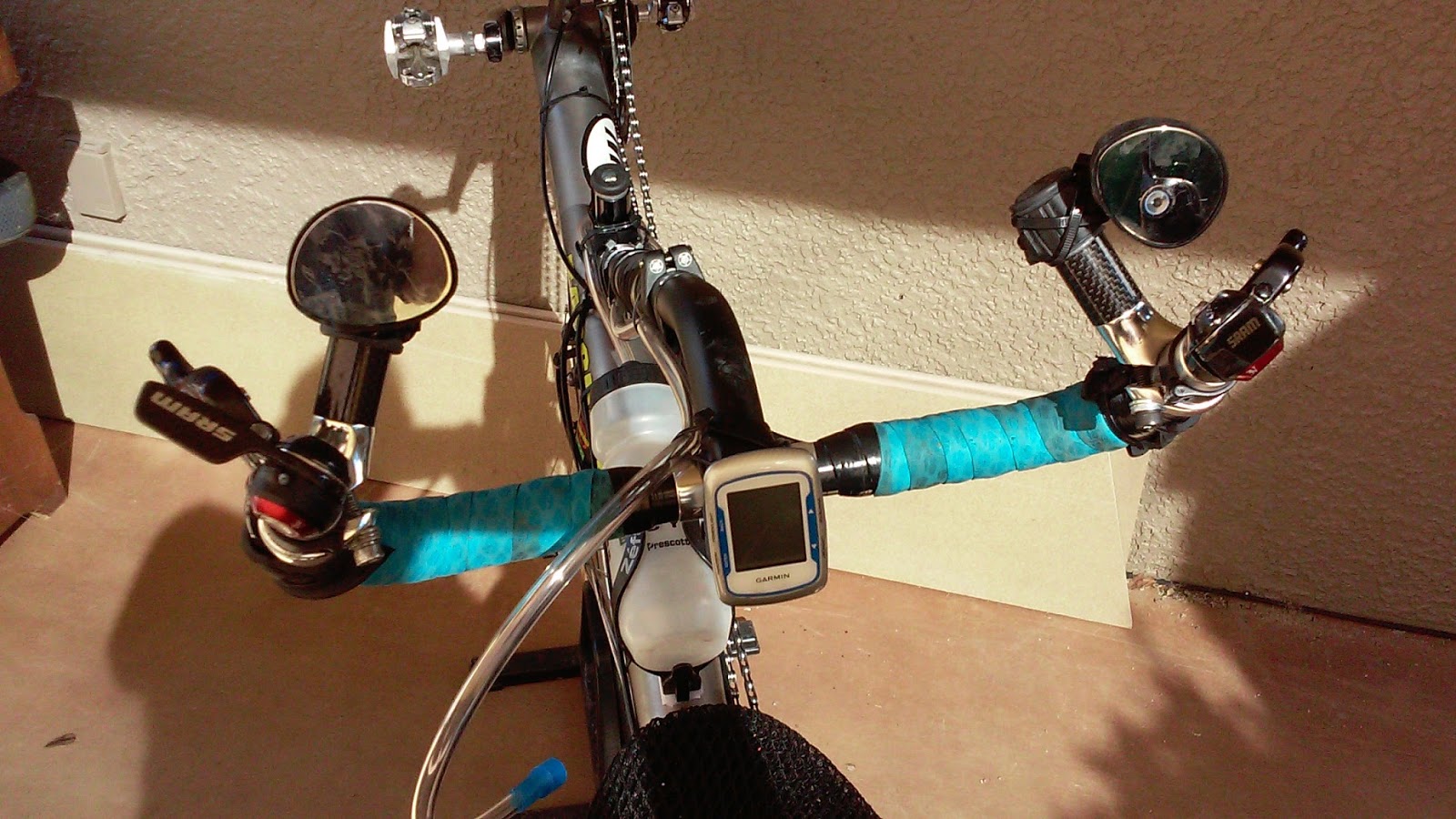
More pics of the Bacchetta Ti Aero I'm Working On


 Starting Things Off Properly


 Cut CFHS seat down to the nubs.

FastBack NorBack Frame Pack.  I cut two holes at one end and cable tied it to the CFHS seat.  I also used industrial strength Velcro to get a firm connection. 


 This is the cable tie holding the FastBack NorBack Frame Pack.


Monday, June 1, 2015

Training - The Hardest Part

Yesterday saw me ending a six (6) week aerobic base training period.  Due to a winter of little physical activity (work and a sports injury) I was 20 lbs overweight and in poor fitness. 

From this point I will be ramping up the time and intensity of my training.  I have set several target cycling events in each of the next five months.  This anchors my training plans.  But `time' and `intensity' have a cost: there is only so much juice in an orange.  That is, I must be careful not to unbalance the rest of my life: family, work, friends. 

I think I got involved in athleticism as a way to modulate a certain `manic' aspect of my personality, a tendency to become overinvolved.  I notice this partly because of a self-reflective bent of mind and partly because of my profession (clinical psychologist).  I'm sure that many of us have such a `manic' propensity, though it may take a different form (job, sports, cooking, etc).

It is `easy' to push aside the more complex and anxiety producing issues associated with maintaining a balance in life.  Other person's needs are complex and require maintaining a disciplined sensitivity from me.  Not so with training.  `Training' can take on an addictive quality: wake up, train, rest/sleep, do it all over again. 

So now training has entered the `hardest' part: maintaining a civil balance in life. 

Thursday, May 28, 2015

Carbon Fibre Hard Shell Seat - Modifications


I've recently modified the steering of the Bacchetta Ti Aero from a stiff riser coming up straight from the fork to a tiller arrangement.  The tiller arrangement allows me to recline the CFHS seat to as low as 4 degrees. 

When the stock CFHS seat is steeply reclined the upward bump at the bottom (toward the steering) becomes a limiting factor.  The stock CFHS seat was not designed for steeply reclined positions (< 14 degrees).  That is, the rider's coccyx is sitting on the `bump,' i.e., the section of the CFHS that bends up.  Uncomfortable and awkward.  When I have to come to a quick stop while in a steeply reclined position my pelvis is raised too high for my feet to fully touch the road.  I wobble like heck in the process because my feet are too high. 

A few years ago, and again today, I sawed off that bend in the CFHS. 
some text

I used a dremel tool to make the cut.  (Goggles and dust mask absolutely necessary). 

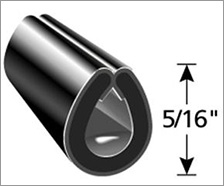
After I made the cut I covered the edges of the entire CFHS with a flexible plastic trim molding.  Insert the edge of the CFHS the cut (see above).  (Note: the trim molding I use is much smaller than 5/16".  See the pic below,)

I then drill very tiny holes into the CFHS and use very small cable ties to hold the molding securely to the edge of the CFHS. 

Then I put the Ventisit pad back on the CFHS.  Looks like this: 

Cutting off the upward bend at the base of the CFHS allows safer stopping and positioning on the bike. 

Tuesday, May 26, 2015

Compared to what?

I'm doing fairly comprehensive upgrades to my bikes.  Hours and hours of careful work.  I'm feeling guilty about neglecting other things (family, work, training).  But then this picture comes into my head:

I'm doing 31 mph on a descending 6% switchback that curves 45 degrees to the right.  A monster truck pulling a horse trailer is coming up in the other lane.  If I get a mechanical or flat tire now I'll just slide under 12 wheels of tonnage.  A mere stain in the road. 

Makes a guy patient in his work.

Wednesday, May 20, 2015

Aerodynamic - Pushing Air

So much of cycling has to do with pushing air.  We think it relatively insignificant because we can't really `see' the air we're pushing.  But those who cycle a fair amount know what it is like to ride into a headwind. 

At `performance' level cycling one of the major determinants of `performance' has to do with reducing your wind profile. 

I've been playing around with `getting aero' in the last few weeks.  Here are some pics of my noodling:


Below are some pics of the relatively `non-aero' position.


In the end, however, it is all about the `engine.'

Tuesday, May 12, 2015

Ankles are Better Than Tails

I'm gonna `pay' for this post, mates. 

---

I recently quit yet another facebook group on recumbent cycling because I got tired of insecure and crazy old men insulting one another with the geriatric equivalent of "mine's bigger than yours."  If you get my drift. 


On an initially civil series of posts from normal people about climbing on a bent a few techniques were discussed.  Relaxing the grip on handlebars; no need to slouch aero if you're doing 7 mph uphill; fast rpm for short bursts; finding your own natural rpm rhythm for those long slogs uphill; bridging to add some rest and variety to climbing muscles; ankle pedaling. 


In the past year I've found that ankle pedaling is nothing less than an amazing aid to adding speed in climbing.  (Losing 20 lbs of fat doesn't hurt, either).  It takes some careful ramping to add powerful ankle pedaling to your repertoire but it is worth it. 


Last year I was climbing the 12.4 mile nonstop incline from Skull Valley to the top of Iron Spring Road with a gaggle of uprights.  After a few miles the gaggle calmed down, having depleted their EPO and testosterone (and when THAT happens it has a diluting effect on the overwheening ego, i.e., they slow down).  Me, being of a tortoise-like temperament to begin with, I began cranking past them, one at a time.


An aside:  There is almost no greater satisfaction for a man in his 7th decade than passing ersatz testostified he-men who are panting and negotiating mortality.  I make myself close my mouth and breathe through my nose, risking oxygen starvation, blacking out, and unconsciousness, just to let them think that I'm not even breathing hard and I'm STILL flicking them off the back. 


Annnnyway.  After I'd get some distance on this gaggle I'd spy one or two accelerating to catch up to "that old fart on the cheater bike."  I'd let the lead guy get to about 5 feet from me and then I'd kick in with the ankle-pedaling.  It was cruel.  It was mean.  It was fun.  I can't wait to do it again.

I literally `felt' their ego deflating, their spirit sinking, their anger and frustration boiling over.  I felt the desire to slow down, let them come beside me so that I could say something like: "Gee!  THAT'S gotta be frustrating, huh!?"


Doing this over and over again to the same guy is even more fun.  More hostile.  Even more cruel. 


It's soooooo good.


Ankle pedaling.  I think it is better than having a tail.

I know.  I know.  I'm gonna `pay' for this blog post.  Have at it, mates.

Saturday, May 9, 2015

Bicycle Helmets


Helmet companies hate me.  I think the last time I bought a new helmet was when I had hair. 

I keep my helmets, too.  In the event one just rots away from the inside out.  Then I can switch to something that might look like a .... 

Most helmets seem to have more holes for ventilation than `stuff' for protection of your head. 

"I'm looking for a good helmet that protects my head and ventilates when it is hot."

"Sure.  We have the `all hole' helmet.  Just a set of straps that go over your head and under your chin, like a brassiere for a single ... "

Recently the straps on my latest helmet became so stiff and frayed that I figured it was time to look into another helmet.  Twenty-first century and all.  The only problem was that most helmets seemed to be built to ventilate rather than protect. 


Image result for bicycle helmet best ventilation
So now I had a fundamental problem:  How do I get a helmet that really protects without making me suffer the insufferable sweat and salty eyes?


A friend (Allan Duhm) who is usually several steps ahead of me in terms of equipment, performance and all around human sociability (the latter isn't a big stretch) recently purchased something that seemed to fit the bill.  The Giro Air Attack Shield.  (Who makes up these names?  Air attack?  Shield?  What is this, third grade?!!)
 
After much searching and reading I purchased one. 
Matte Black and White
 
I'm somewhat timid about looking like a fashionista on a bike.  For years I avoided fancy bike clothes and gear, wearing instead cutoff jeans and sneakers.  But I wasn't going to pay a lot of money for a helmet that was mostly holes and designed in such a way that if I DID fall on it my neck would twist and sever my head.
 
Today I wore the new helmet.  I like it.  I'm glad I bought it.
 
It was cold and windy up here in the mountains.  It was very sunny today.  The helmet provided protection from the cold without sacrificing ventilation.  I'm also glad that I didn't have to lather up my very bald pate with sunblock. 
 
The `shield' is better than a visor in many ways.  It is both a windblock and a shade against a glaring sun.  I was worried that the `shield' would blow off on a fast, windy descent.  Nope.  Designed with perfect wind ergonomics. 
 
Something worth considering for yourself. 


SRAM X01 Grip / Twister Shifter

Living in the uppy-downy switchback thick terrain of Prescott I do a lot of rear cassette shifting.  But not so much FD shifting.  As much as I like the SRAM TT900 lever it has become both a small danger and annoyance. 
 
Shifting to a lower gear means that I have to pull on the lever, having a slightly destabilizing effect on the steering.  As well, pulling on the lever requires me to move my right hand off the handlebar, position the lever in the palm of my hand, push/pull up on the lever and then replace my grip on the handlebar.  That may sound like a minor step but when you're navigating switchbacks, up and down, it can be ... slightly dangerous and certainly annoying.
 
Hence my recent replacement of the SRAM TT900 right lever with the SRAM X01 Grip Shifter.  A mountain bike shifter.  Properly installed it allows for quick, one motion, shifting.  And to my surprise it is incredibly light. 
 
- d
 
https://www.sram.com/sram/mountain/products/sram-x0-grip-shift
 

Tuesday, May 5, 2015

A Few Pictures from my Training Route

Immediately south of the city of Prescott is a section of the Prescott National Forest.  This section of Arizona is known as the `transition zone.'  That is, where the Colorado Plateau peters out and drops off into the `central basin,' the desert.  In the not so distant past there was a great deal of volcanic activity NE of the Flagstaff area.  Further southwest, near Prescott, the earth simply sunk 4,000 or more feet over a 150 miles. 

So ... what this means is that my training route is very hilly, sometimes steep, always windy.  This is the RWGPS link to the 28.3 out and back I did Sunday, May 3rd.  http://ridewithgps.com/trips/4565503

For half of the out and back I'm descending.  That means, if the total climbing was 2,800 feet it was accomplished over 14 miles, for an average of 200 feet of climbing per mile.  Mighty steep. 


This was taken at the highest point: 6100 ft elevation.

 
An indication of the endless switchbacks.  Motorcyclists use this road to run into one another or off the cliffs.  Twenty-two road shrines on 14 miles of road -- all motorcyclists. 


Always nice to get a preview of the road below.  

Friday, April 10, 2015

A Surprising Discovery - Sleep

Today, during the fourth of five physical therapy sessions, the therapist asked if I had had many other sports related injuries over time.  Aside from leaving sheaths of my skin on the chipseal and skinning my elbow down to the bone several times and getting some stitches for the same on one of my knuckles and fracturing a few ribs once ... "No.  Not many." 

So these past few months of indolence due to the ripped ulnar nerve from indoor rowing are unprecedented.  But they're pretty much in the past for now.  And I am finding the time to get out on the bike to begin training again. 

Yesterday I spent about 5 hours cutting wood, pounding nails, etc. in the process of building a workbench in the shed.  Lots of lifting, pushing, bending, stooping, etc.  By dinner time I was pretty tired and sore.  Felt good, in fact.

Today I rode the bike for a few hours. 

On returning home I showered, etc., in preparation for a few meetings in the afternoon.  While doing some computer work I felt a heavy wave of sleep overwhelm me.  An hour later, my feet up on my desk, I awoke. 

THAT is what I missed all of these months.  The bliss of intense, blind-to-the-world sleep. 

Tired.  Sore.  Sleep. 

It is free.  Costs nothing but labor. 

Tuesday, March 24, 2015

The Only People Without Problems ...

... are either gone from this earth or on their way in. 
 
The rest of us have to get up every morning and figure out how to make it to the end of every day. 
 
Problems are essential to the athlete.  And to the rest of us. 
 
We can `react' to a problem in an impulsive, emotion-encumbered way.  Or we can `respond' to a problem from the `neck up.' 
 
When the bike goes off the road or gets caught in a road crevice we have to `react' fast in order to be safe and survive. 
 
When we approach a traffic-heavy intersection we have time to `respond,' to consider the best solution to potential danger. 
 
In both cases we are called to deal with a problem and come out the other side. 
 
As for `training' (the name of this blog). 
 
Joe Friel shouldn't be an unfamiliar name to competitive athletes.  I've read his many books and followed him on his blog for years.  What many may not realize is that he is in his 70's and suffered a serious bicycling accident and injuries in January of 2014. 
 
"The biggest consumer of my time in the last nine weeks was related to recovering from a bike crash on January 24. That resulted in seven broken bones including the clavicle and scapula, a concussion, blood clots in both legs and lungs, a partially torn rotator cuff and shoulder labrum, and what docs call “adhesive capsulitis” (also called “frozen shoulder”). After six days in the hospital trauma center, all of these injuries required numerous trips to various medical specialists, X-rays, CT scans and an MRI. Then there have been three weekly visits to my physical therapist going on since late February. All of this left little time for anything else." (Link)
 
I strongly recommend his work.
 
Training involves `problems.'  Not all of them have to do with finding the time to train, deciding on the best nutrition and diet, getting your workout plans implemented, or fitting yourself with the equipment that helps you achieve your goals. 
 
In Joe's case it involved dealing with a major injury, the impact that age has on his recovery, and, I'm certain, his own assessment of himself now that he is truly among the `elderly.'  (As am I).
 
As I write this blog entry I'm probably within 15 minutes of his home nearby Scottsdale, Arizona.  My wife is dealing with a problem she has had for many, many years that is in another stage of solution / management: knee replacement.  A talented and experience surgeon spent 50 minutes cutting, sawing, gluing and hammering to `install' a new knee joint. 
 
Joe's problem required a rapid and urgent `reaction.'  My wife's problem required a thoughtful and deliberate `response.' 
 
Both Joe and my wife are now engaged in a form of `remaking' of themselves in pursuit of the challenges ahead. 
 
Lucky they have problems.  Think of how empty life would be without problems. 


Sunday, March 15, 2015

Death Rides The White Spars

Did a short out and back to MP 305 on the White Spars today. 
 
Sunday.  Muscle cars, 18 wheelers and parades of checked-out motorcyclists.  Seems that they were all competing for the entire year's Darwin award quota in one day. 
 
I'm hugging the fog line while ten testostified Camaros crossed the double yellow line on blind switchbacks.  Pushing 60 in a 35 mph. Causing vehicles from the opposite direction to dive into the rock face. 
 
Twenty motorcyclists, pitched at 35 degrees, ignorant of oncoming vehicles, 120 degree switchbacks, easy 50+ mph, rubber on the descents, cranking the loudest noise their machines could make.  Did you know that there is an inverse relation between the loudness of your toy and the size of your ... ?
 
And then the 18 wheeler, blithely winding it's way south past MP 305.  I was tempted to roll down to MP 302 to see how many guardrails the driver took out; to find out if he lost his load on that impossible switchback. 
 
The season should clean out the witless twits before only the sane remain. 

Check the body bag inventory. 
 

Thursday, February 26, 2015

I Feel Better Now

Four weeks of up and down `pushing the pain threshold.'  What was a subjective level 9 pain four weeks ago is probably a solid subjective level 5.5 now. 
 
Objectively, as well, the level of pain is much reduced.  
 
"I Feel Better Now."  I actually was happy to read that a famous basketball star was going to be off the court for 10 weeks while a torn muscle and pinched nerve healed.  When the man with no shoes sees a man with no feet.  Always "compared to what?"
 
An important experience for an athlete of any age: 29 (basketball star) or 69 (me).
 
Many dimensions to such an experience.  From a greater and personal appreciation of the difficulties people with chronic pain have to deal with (your world gets smaller and smaller, hemmed in and smothered by pain).  To an intriguing learning process of anatomy, physiology and pharmacology.  Not to mention the varieties of positions in which one learns to sleep. 
 
--
 
Two weeks ago the central highland area of Arizona saw sunny days and warm weather.  The last week was cold (though nothing like the Midwest and east).  Coming our way for the next week is rain and cold. 
 
During the warm weather I was feeling sorry for myself while I couldn't train and struggled with the pain.  Now that I feel better it is good fortune that mother nature is enforcing the `no biking' rule.  A hedge against risking a too soon return to the rough and tumble of training. 
 
Instead I will be restricted to indoor activities, specifically the elliptical.  Aerobic effort and increased time on the machine.  Another two weeks and .... I hope for warmer weather.  Another two weeks and .... I hope to return to outdoor training on the bike. 


Wednesday, February 4, 2015

Radiculopathy - PINCHED NERVE

I think I'm correct in the identification of an overuse injury to the nerve exiting my C7 vertebra.  A pain that begins in the muscle near the scapula and extends and descends down the posterior of the arm to the little finger.  As it approaches the little finger the pain sensation changes to a pronounced tingling.  Things that can cause the Cervical Radiculopathy include ... uh huh ... rowing a boat.
 
It should have been enough that I sensed this pain two days and 30K meters before I stopped rowing. Too much is never enough. (So say the walking wounded).
 
The pain was very intense for a few days, resulting in loss of sleep and a fair amount of restricted upper body mobility.  The third day into this I started the NSAID ibuprofen.  200 mg every 6 or 8 hours at first.  Little improvement.  The fourth day I increased it to 400 mg every 6 to 8 hours. 
 
By the fifth day the intensity and sensitivity reduced significantly.  Thinking that the acute stage of the injury had passed I began working out on the elliptical, using my arms about half the time (30 minutes) with very little intensity.  On the sixth day the pain was almost entirely gone.  I felt fine lugging some groceries during the day.  In the evening, while sitting at my desk and leaning back in the chair I felt the return of the pain.  That night I was unable to sleep due to the pain and ache. 
 
At this point (day seven) I will be cutting back on the NSAID and will be seeing the doc.  I expect that I will get a cortisone shot and instructions to hold back on the elliptical and a return to household chores, etc.  Or, he may just slap me upside the head and tell me that my penance for `rowing through' is another week of agony. 
 
Pinched nerves are reported to take about 6 to 8 weeks to fully remediate.  Mortality does, in fact, suck.
 
UPDATE: Wednesday, Feb 5th.
 
Went to the doc this morning and he explained it to me in a way I can understand, so that I can manage my own responsibilities carefully.
 
 
When I overextended my reach on the indoor rower (erg) the peripheral nerve passing through the cervical (C7) vertebra was stressed over and over again. The repeated stress of that nerve (that goes down the posterior of the right arm to the little finger) resulted in an irritation and inflammation. The fibers of the nerve `complained' to their boss (central nervous system in the vertebrae), and the boss complained to what in most other people is their brain.
 
I, of course, being of the ultra-this-ultra-that mentality, interpreted all of the complaining as pissy little whining and ignored it. I punished the complainer with
more stress. 
 
I lost. 
 
Treatment?
  • Ibuprofen at levels that, temporarily, can be sustained by my system. (400 mg 3 x day) A small increase in blood pressure. Retention of water (weight gain). But it will reduce the inflammation (NSAID).
  • Treating my right arm and hand carefully. No heavy stresses. No lifting of weights, etc.
  • No extension of the neck (like when in slouching in a chair watching TV, or reading in bed).
  • Alternating application of hot and cold (no more than 20 minutes each) on area where the peripheral nerve exits C7 (right side).
  • A massage around the muscles in that area to relax them and loosen things.
  • It couldn't `hoit' if I stood under a hot shower and rotated my head and shoulders.
 
By the time I'm finished with this body I might actually learn something about how it works.
 
HERE is a really great little slide show that explains this common cause of such pain. Excellent and easily understood.

Tuesday, January 20, 2015

Afraid to Win

I'm not emotionally mature enough to be a good sports competitor. 

I avoid competition with others.  I don't fear competition.  But I avoid it because it dredges up so many ugly parts of my personality. 
 
I'm juuusstt beginning to understand the edges of me and cycling competition.  Just a peek under the covers at this point. 

How do I know this?  Because I don't take sports competition seriously.  I take it GRAVELY. 

Victory or death.  At least that is the silent message I've given myself all these years.  Crazy.  Absolutely crazy. 

I am in over my head.  I shut down all other parts of my life.  I'm all gas pedal.  No brakes.  Even less steering.  Just a big glob of dangerous intensity. 

Dangerous.  That isn't a macho compliment. 

I'm all `below the neck' and very little `above the neck.'  A sure fire guarantee for reckless failure. 

And I succeed sometimes only due to dumb luck.  Weather.  Bad luck on the part of others.  Suspension of the laws of physics.  (There have been times when tragedy escaped me.  And I still don't know how, let alone why).

Though I've never actually cheated in sports I am a hair's breadth from attacking my fellow sports competitors.  More than aggression.  Outright hostility.

Attacking.  Like ... pushing them, physical assault, making them stop for good.  It's right there in my mind, in front of me.  My whole body wants to stop the other competitor. 

Maybe I stop myself from competing for fear that I'll actually do something that I would regret, feel ashamed about.  Maybe not competing, not trying to win, is a kind of an unconscious restraint. 

If I fear doing destruction to others, and am unaware of the psychological dynamics underlying this fear ...

I became aware of this desperation only recently.  And I don't really know why this insight has bubbled to the surface at this time and place.  But it helps. 

It helps because this awareness allows me to more carefully and thoughtfully identify cycling competition goals.  And to train more thoughtfully. 

For example, here is what I'm thinking about now, in advance of the coming warmer months: 
 
  • Participate in more short competitions.  That is, shorter distances. 
  • Why?  Because being in the mix of competitions more frequently will allow me to get closer to the part of me that gets undone. 

I need more time. 

Action Defines Us.